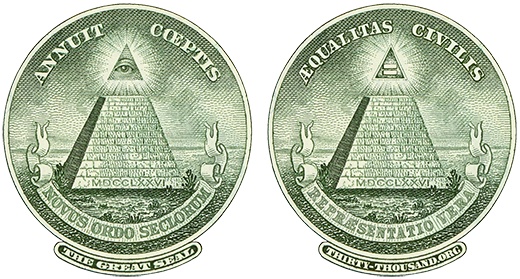
The Enduring Textual Illusion of “Article the first”
How a Single Inverted Word in the 1789 Apportionment Amendment Has Fooled Experts for Two Centuries
On May 14, 2026, Rep. Darrell Issa (R-CA) introduced the Congressional Apportionment Amendment Deadline Act in order to impose a firm ratification deadline of December 31, 2026, on the so-called “Congressional Apportionment Amendment”,1“Congressional Apportionment Amendment” is a modern label rather than an official designation. H.J.Res.186 references that label in its operative text without actually explicitly defining it or citing the text to which it refers. It is, in fact, referring “Article the first” of the Bill of Rights. The 1789 enrolled resolution passed by congress assigned the twelve proposed articles of amendment no titles—only the ordinal labels “Article the first” through “Article the twelfth”. No statute or official publication has ever formally named this proposal; government sources, including the House’s “Unratified Amendments” document and the National Archives, refer to it descriptively. which was proposed in 1789 as “Article the first” of the Bill of Rights.2Whether Congress may attach a ratification deadline to an amendment that was proposed without one (more than two centuries ago) is itself an unsettled question of Article V law, which the resolution’s two-page text does not address. Issa’s rationale was explained as follows:
The Madison amendment proposed that Congress’ number of Members be determined by a formula (not by population) that would currently result in something akin to 5000 MOC [Members of Congress]
Our joint resolution would sunset the amendment so it could not be considered further after Dec 31 of this year.”3This explanation was provided in a June 3, 2026, email to Thirty-Thousand.org from Rep. Issa’s Communications Director. The amendment’s formula is in fact expressed as a series of population ratios. The email’s parenthetical presumably refers to the fact that, under the amendment, the size of the House would be dictated by the constitutional formula itself rather than left to Congress’s discretion, as it has been since the total was fixed by statute.
As stated in the quote above, Issa wants to prevent the ratification of the very first amendment proposed for the Bill of Rights because he fears that would bring about a House with thousands of members. It is commonly believed, in fact, that if this proposal were ratified, it would establish a minimum size for our House of Representatives of one member for every 50,000 people which, based on the most recent census, would be over 6,000 Representatives. Though Thirty-Thousand.org has been advocating for a 1:50,000 representational ratio since 2004, for reasons explained in this article, we believe it makes perfect sense to not ratify the first Article as it is actually worded. Why? Because were it to be ratified, its actual effect would not only be strikingly different from what is commonly expected, but it would actually prevent our republic from ever achieving the level of representation intended by our founders.
The notion that the first Article’s ratification would require a House with thousands of members has been pervasive ever since it was first proposed. That misperception is based on a profound misreading of the amendment’s actual text—a misreading that also conceals an enduring mystery of American history. Suffice it to say that Rep. Issa is far from alone in making this mistake.
The 237-Year-Old Textual Illusion
The version of the first Article sent to the states in 1789, reprinted below, contains phrasing that has been spectacularly misread for over two centuries:
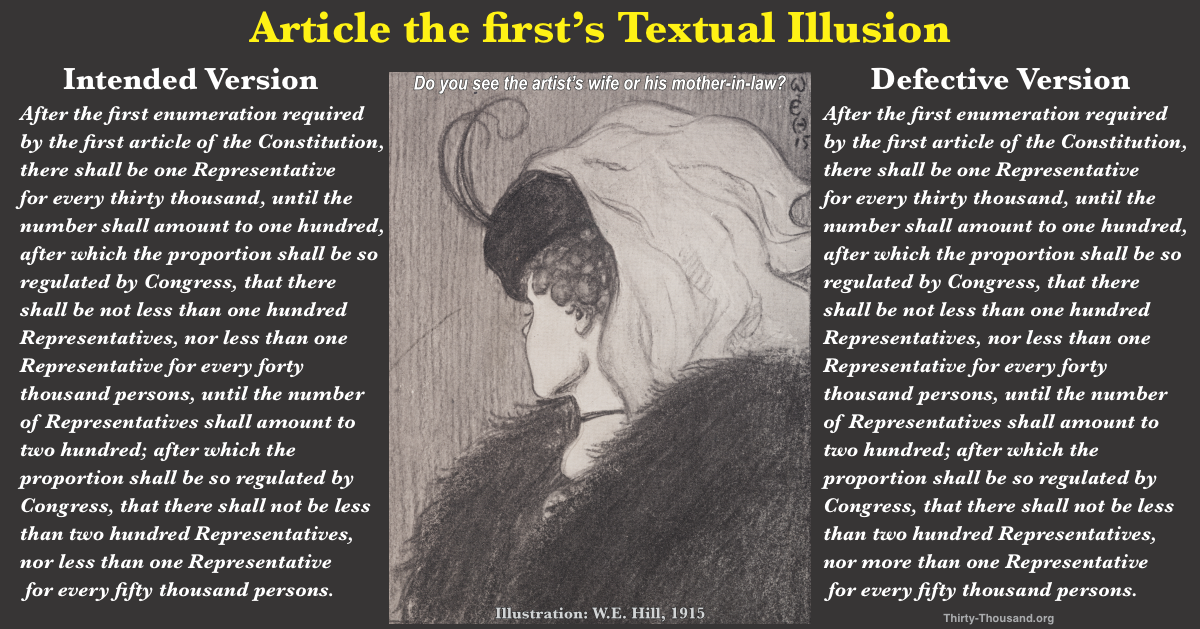
“After the first enumeration required by the first article of the Constitution, there shall be one Representative for every thirty thousand, until the number shall amount to one hundred, after which the proportion shall be so regulated by Congress, that there shall be not less than one hundred Representatives, nor less than one Representative for every forty thousand persons, until the number of Representatives shall amount to two hundred; after which the proportion shall be so regulated by Congress, that there shall not be less than two hundred Representatives, nor more than one Representative for every fifty thousand persons.”4The full text is quoted from the National Archives’ transcription of the enrolled original Joint Resolution, on permanent display in the Rotunda for the Charters of Freedom: archives.gov/founding-docs/bill-of-rights-transcript.
Note that in its final clause, the proposal contains the phrase “nor more than,” which creates an upper limit, or a ceiling, on the number of Representatives that can be elected to the House. For example, based on the 2020 census apportionment population (331,108,434), the version of the first Article that was sent to the states would simply allow Congress to choose any House size between a floor of 200 and a ceiling of 6,622 Representatives.5Applying the defective text’s ceiling of one Representative for every fifty thousand persons: 331,108,434 ÷ 50,000 = 6,622.2 (round down).
However, for reasons explained in this article, nearly every reader misreads that ceiling as a floor. In fact, for more than two centuries, careful readers—including lawmakers, scholars, historians, and even the National Archives—have consistently read “nor more than” as if it were “nor less than,” which is exactly how the clause was worded in its coherent predecessor previously passed by the House and then reported in the press.
That predecessor—which we call the intended version—would have required that the House grow steadily with the total population in order to keep Representatives close to the people. It did so by completing a design the Constitution had left half-finished: The Constitution already set the ceiling—no more than one Representative for every thirty thousand persons—but provided nothing explicit to force the House to grow with the population.
The intended version added the matching floor—no fewer than one for every fifty thousand—so that no district could grow too large and the House would expand after each census. A single altered word demolished that design, inverting the intended floor into a second ceiling (which nobody had sought), thereby leaving nothing to ensure that our representation would grow with the population. For this and other reasons that will later become apparent, we call the version sent to the states the defective version. The two are set side by side below.
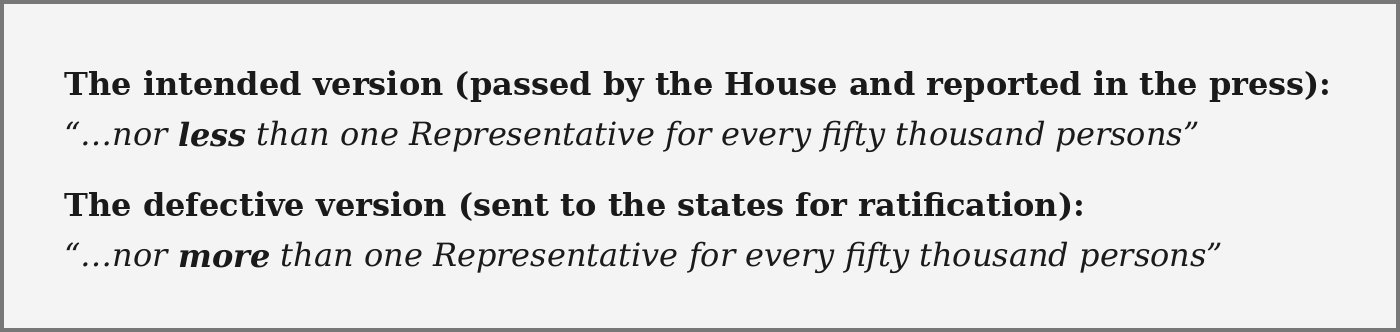
For 237 years, the version of the first Article that was sent to the states has held a mystery—one this article will reveal.
Even the Experts Have Been Misled by the Illusion
The original Bill of Rights—the engrossed parchment containing all twelve proposed amendments—is on permanent display in the National Archives’ Rotunda in Washington DC, where it is viewed by over two million people annually. Replica copies are one of its store’s long-running core products, and can also be downloaded from their website. To commemorate that historic document, on December 7, 2010, the National Archives issued a press release in which they stated:
“Had this been ratified, there would be far more than 435 members of Congress – nearly 6,000. Currently, each member represents on average about 650,000 people.”
The first Article’s defective text was even printed immediately above that statement. Despite that, this textual illusion is so seamless that the nation’s official keeper of historical records—a highly respected institution whose entire mission is textual precision—read the amendment exactly as Rep. Issa’s office does today.
The Archives is in distinguished company. In 2021, four prominent scholars of American politics published The Case for Enlarging the House of Representatives under the imprimatur of the American Academy of Arts and Sciences—a cross-partisan report making the case that the House of Representatives should be enlarged.6Lee Drutman, Jonathan D. Cohen, Yuval Levin, and Norman J. Ornstein, The Case for Enlarging the House of Representatives (Cambridge, Mass.: American Academy of Arts and Sciences, 2021), pp. 8, 20. The amendment’s defective text is quoted in full in the report’s own endnote 9 (p. 31), and its Table 1 likewise presents the 50,000 figure as the operative per-district ratio for a House above 200 members. Thirty-Thousand.org concurs with the report’s core conclusion—that the House must be enlarged—though not with its modest scale (an additional 150 seats) or its recommended pairing with multi-member districts. It asserts that the 1789 amendment “set a formula for regular House expansion,” which today would yield “roughly 6,500 seats.” And though the report’s own endnote correctly quotes the amendment’s “nor more than” language, the authors interpreted it as though it read “nor less than.” The report’s authors are not alone among serious scholars: The constitutional historian David E. Kyvig, whom they cite, likewise read the clause as a mandate to enlarge the House, not the ceiling the enrolled text actually sets.7In his acclaimed history of the constitutional amending process, Explicit and Authentic Acts: Amending the U.S. Constitution, 1776-1995, Kyvig first misread the clause as perpetually fixing a maximum district size of 50,000 residents—the same inversion described in this article. Ten years later he offered an alternative “graduated” construction which assumes that the clause’s three ratios are the opening sequence of a perpetually ascending schedule. Both of his interpretations would mandate a House larger than today’s 435 but, as it turns out, neither interpretation is correct, as explained here https://thirty-thousand.org/blog/kyvigs-first-article-reconstruction.
What makes the illusion’s persistence even more inexplicable: The defect has not gone undocumented. Thirty-Thousand.org has been calling public attention to the inverted text for more than two decades, in material long since indexed by every major search engine. The Archives’ 2010 statement, the Academy’s 2021 report, and H.J.Res. 186 itself all post-date that documentation. The illusion does not merely survive a careful reading of the amendment; it survives the published correction sitting one search away.
The misreading so dominates the written record that, as of this writing, today’s leading AI language models, trained on that record, reproduce it as readily as any human reader—describing the proposed amendment as a mandate to enlarge the House—until its underlying arithmetic is spelled out for them.8The point is not that these AI systems are inherently unreliable, but that the misconception is built into the corpus upon which they are trained. Asked to analyze the proposed amendment, leading models—including those developed by Google, OpenAI, and Anthropic—independently assumed, exactly as most human readers do, that ratifying the first Article would compel a larger House, and they construct entire arguments atop that premise. In one such exchange, Google’s Gemini described Thirty-Thousand.org as advocating ratification “to drastically expand the House,” treated H.J.Res. 186 as an effort to block that expansion, and even placed the defect in the wrong clause; only once the ceiling arithmetic was demonstrated did it reverse course, calling the corrected reading “a plot twist.” Because such models distilled the consensus of their sources, the uniformity of the error measures how thoroughly the misreading has come to dominate the written record.
This is not a failure of intelligence. It is a testament to how readily the mind can misread a single word. The illusion succeeds because our brains are wired for pattern recognition. Before the reader ever reaches Article the first’s third and final clause, the amendment has already established a drumbeat of floors—“not less than one hundred Representatives,” “nor less than one Representative for every forty thousand persons,” “not less than two hundred Representatives”—conditioning the mind to expect the pattern to complete with one more. And the final clause echoes the second of those floors almost word for word—the same construction, the next ratio in the sequence—except that “less” has become “more,” one four-letter word swapped for another. By the time the eye hits that single inverted word, expectation bias has taken over: The brain seamlessly auto-corrects “nor more than” into “nor less than” to preserve the seeming logic of the clause.
There are actually well-established psychological bases for this perceptual phenomenon known as the “semantic illusion” as well as the confirmation bias.9Psychologists have documented this class of error as the “semantic illusion” (often called the Moses illusion), in which readers fail to notice an incorrect word because context and expectation override the text actually printed. Confirmation bias—the tendency to favor information that fits prior beliefs—helps explain why the misreading, once made, is so rarely revisited. The text reads so plausibly that the mathematical defect only reveals itself if an exceptionally careful reader happens to calculate the total number of Representatives required for any population between eight and ten million.
This illusion is also self-perpetuating. A reader confused by the clause who turns to the internet for clarification will usually find the misinterpretation waiting there as well, repeated in encyclopedia summaries and official resources alike.10As of June 8, 2026… The National Archives’ “Pieces of History” blog (January 23, 2020) quotes the amendment’s defective text in full and nonetheless concludes that, had it passed, “we could have more than 6,000 representatives today.” Grokipedia’s article quotes the enrolled text verbatim yet describes the clause as a measure to keep districts from “growing excessively large,” reading the ceiling as though it guaranteed a floor. Wikipedia, to its credit, flags a possible “scrivener’s error” in the final clause, yet its opening summary still describes the ratio as climbing to one Representative for every fifty thousand. Though the published correction exists, it has been greatly outnumbered by the misinterpretations provided by widely referenced sources. Each misreading lends authority to the next, so that anyone who misunderstands the first Article’s effect will have their misperception confirmed.
Why Didn’t Article the First Pass Back in 1791?
When the states completed the ratification of the last ten of the twelve proposed articles on December 15, 1791—which later became known as the Bill of Rights—the first Article was not among them. It had, however, come remarkably close, falling just one state short on two separate occasions. At the end of 1791, ten state legislatures had affirmed the first Article, one shy of the eleven required for three-fourths of the fourteen states then in the union. When Kentucky became the eleventh to ratify in June 1792, the union had grown to fifteen states, raising the requirement to twelve—and the first Article was again one state short. The ratifications then simply stopped, and Article the first subsequently faded from public memory. As explained in our overview of Article the first, there were several significant reasons it was abandoned, two of which are described below.
The most astonishing reason is the irresolvable math problem resulting from the alteration made to the House’s coherent version during the frenzied haste of closing out Congress’s first session in September 1789. As shown in the inset below, this alteration rendered the version that was proposed to the states incoherent: For any total population between eight and ten million, the amendment’s final clause sets a proportional maximum size for the House that is below its own required minimum of 200 Representatives.
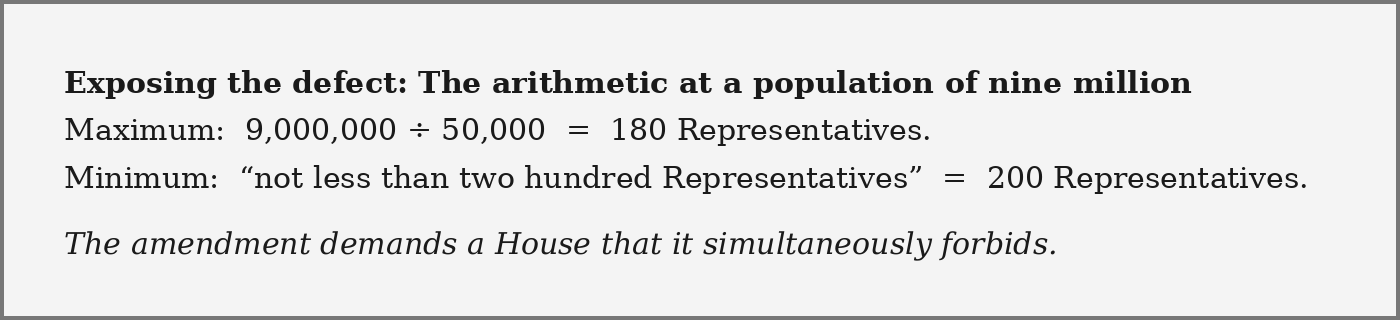
Not only is this an impossibility, but it would have later created a constitutional crisis as a result of the 1820 census (explained below). That impossibility is, in itself, the clearest evidence that the alteration was never the considered will of the Congress. Having just approved coherent, perpetual proportional-growth formulations in both chambers, the esteemed gentlemen of the first Congress would surely not have wittingly replaced them with an irresolvable formula that sets a ceiling below its own floor. Clearly that was an unintended alteration rather than a deliberate policy choice. Whether that inversion was an innocent mistake or a result of intentional manipulation is a question that deserves—and will receive—closer examination in the future.
Though the historical records of the state legislatures’ deliberations on the proposed amendments are very limited, enough is available to confirm that this defective formulation was identified by some legislators as an insurmountable problem. The most comprehensive records come from the Pennsylvania legislature’s lower house when they deliberated on the first Article in September 1791, having already declined to ratify it 17 months earlier. In their legislature, the proposal was championed by Albert Gallatin—widely regarded as one of the finest analytical minds of his generation, and later the longest-serving Secretary of the Treasury in American history. Yet the figures Gallatin presented to his colleagues contained two erroneous values that glossed over the proposal’s fatal flaw.11In his calculations presented to the Pennsylvania lower house, Gallatin mistakenly projected that a total population of nine million would yield 200 Representatives, failing to realize that the text’s literal formulation actually capped the House at 180 seats for that population tier. By incorrectly smoothing the mathematical progression, his figures inadvertently masked the structural contradiction that Richard Wells subsequently exposed. A complete transcription and mathematical analysis of Gallatin’s figures will be published Thirty-Thousand.org, along with the records described in the following footnote. The most likely explanation for Gallatin’s errors is that he simply could not conceive that a Congress comprised of so many esteemed founders—Madison, Sherman, Ellsworth, and their peers—had proposed something absurd, and so he presumed a sensible interpretation of it.
It fell to a less celebrated colleague in Pennsylvania’s lower house, Richard Wells, to evaluate the words exactly as written—and, in doing so, expose what Gallatin had smoothed over. Applying Benjamin Franklin’s famous population-doubling model, Wells calculated that the 1820 census would count roughly nine million people (the same as the example provided above). Wells’ hypothetical placed the nation squarely inside the impossible zone—and so he declared that the proposal “bore a contradiction and an absurdity in the very face of it.”12The September 1791 deliberations of the Pennsylvania legislature survive in contemporaneous newspaper accounts preserved on microfilm. Our digitized images of those records—together with a full reconstruction of the state legislatures’ deliberations on the proposed amendments, including the particular circumstances of Pennsylvania’s eventual ratification—will be published as supporting documentation to a forthcoming paper further examining the first Article’s nearly imperceptible defect. As it turns out, Wells’ prediction validated Franklin’s model: The 1820 census counted 8,969,878. Had the amendment then been in effect, no constitutionally valid apportionment would have been possible. Pennsylvania ratified the first Article nonetheless, and Kentucky followed the next June. No other state ever did.
The second reason this proposal was abandoned stands entirely apart from the irresolvable math: It offered a House with a permanent minimum of only 200 Representatives. There is no reason to expect that a majority of the states’ legislators would have been satisfied with that. Many of their states’ conventions previously had explicitly demanded a proportional minimum—a House guaranteed to grow along with the population so that their political voice would not be diluted. A fixed floor of 200—which would allow the People’s House to eventually become a proportionately tiny and unrepresentative body as the nation grew—was simply not what the press reports had led them to expect.
What makes this history particularly interesting is that the intended version of the first Article—the coherent proposal passed by the House earlier—would have done exactly what most people assume the defective version would do: Once the nation’s population exceeded ten million, it guaranteed a minimum of one Representative for every fifty thousand people. The Senate’s version of the first Article followed the same pattern, offering a simplified formulation that would have required a House size of one Representative for every sixty thousand. Those two precedents are a critically important aspect of this history, as they clearly evidence Congress’s true intent.
This history also corrects a misperception that the states rejected the proposed amendment because they did not want a substantially larger House. The record shows the opposite: As noted above, many of the states’ conventions had demanded a House guaranteed to grow, but what they rejected was a text that failed to deliver that guarantee. And the apportionments Congress subsequently approved demonstrate that the initial coherent proposal was the intended version: For the first five apportionments (1790 through 1830), Congress sized the House in compliance with what the intended version prescribed—even when the defective text would have forbidden the result—acting, in practice, as though the coherent version were the law.
Given all that, and given the widespread demand for such an assurance, there is every reason to believe that had the intended version been sent to the states, it would have been ratified alongside the other ten articles. Instead, the states received the altered text.
The Founders Expected a House That Grows With the People
Regardless of how the defective formulation came into being, that single inverted word led our republic down the wrong path, as it effectively sabotaged the founders’ vision of a genuinely representative body. For them, the size of the House determined whether representation would be real, a principle plainly stated by John Adams:
“[The representative assembly] should be in miniature, an exact portrait of the people at large. It should think, feel, reason, and act like them.” 13John Adams, Thoughts on Government (1776).
An “exact portrait” requires detail in proportion to its subject—and as the people grow in number and variety, only a House that grows with them can continue to reflect their true composition.
When the Constitution’s defenders promised the people a representational ratio of one for every thirty thousand—a promise made repeatedly in the Federalist Papers—they attached no qualifier or expiration date. And they understood the arithmetic of that promise: Federalist 5514While most scholars attribute Federalist 55 to Madison, a stylometric analysis indicates it was coauthored with Alexander Hamilton, explained here: thirty-thousand.org/supplemental/federalist55_authorship. expected the first census to raise the House to at least one hundred members, then two hundred within twenty-five years and four hundred within fifty—by the 1840s. In other words, they expected the House to double roughly every generation, a fourfold rise within fifty years (pursuant to Franklin’s model). Unfortunately, by 1840, the founding generation was no longer around to preside over the grand republic they had created. The 1840 census should have resulted in a House size between 319 and 530.15At the 1840 apportionment population of 15,908,376, the intended version’s 1:50,000 floor would have required at least 319 Representatives, while the Constitution’s own 1:30,000 minimum-district rule permitted at most 530. (Population per Balinski and Young, Fair Representation.) Lying within that range was Federalist 55’s expectation for 400 Representatives, a vision that Congress could have easily fulfilled.
Instead, Congress chose to grant only 223 Representatives, a decrease of 17 from the previous apportionment! It is sadly evident that by 1840, the founders’ vision for a truly representative House was abandoned by ambitious politicians focused on maximizing their political power. It was a republic if we could keep it, and that is the moment that we began to slowly lose it.
It took an additional seven decades for the number of Representatives to finally exceed four hundred, when it reached 435 in 1913. Then in 1929, Congress froze the House at that size with the Permanent Apportionment Act. To provide context, we should consider the world of 1929: Because commercial aviation was then a costly novelty flown by a wealthy few, a member of Congress reached Washington by rail — and fewer than half of American households even owned a telephone, with long-distance calls being expensive. A legislature of that era had to convene bodily in a single chamber, its members coordinated by mail and limited telephony, so a substantially larger House may have seemed to be a significant logistical challenge. That challenge has since vanished entirely, but not the antiquated representational limitation built upon it.
In Federalist 55, the founders’ arithmetic reached well past their projection of four hundred members by 1840: “according to the computed rate of increase” that same progression arrives at “six or seven thousand” Representatives eventually16The “six or seven thousand” is no invented figure: Extend the essay’s own “computed rate of increase”—the doubling that carries the House to one hundred, two hundred, and four hundred Representatives within fifty years—about a century further and it arrives there. The essay raises the number in a separate passage, cautioning that an assembly so large would court “the confusion and intemperance of a multitude.” Yet that apprehension was never converted into a limit: When the same generation reduced the promise to binding language in 1789, the House and Senate versions of the first Article each set only a floor and left the upper bound open. Though it anticipates that figure with unease, warning against assemblies large enough to invite “the confusion and intemperance of a multitude”, that apprehension was never turned into a limit: Neither Federalist 55 nor the amendments the first congress actually proposed any ultimate limit.
The surest proof that perpetual growth was widely embraced is the vote Congress took to advance it: Proposing a constitutional amendment requires the concurrence of two-thirds of each chamber, and the House and the Senate each gave that supermajority to its own version of the first Article — both versions coherently worded to guarantee a House that expands proportionately with the population in perpetuity.17The House’s version set a permanent floor of one Representative for every fifty thousand persons; the Senate’s version set a fixed ratio of one for every sixty thousand. The chambers differed slightly on the ratio, but each version mandated a House that would proportionately grow with the population without limit. As confirmed by its entire legislative history, the essential purpose of Article the first was to ensure that our House would forever grow along with the nation’s population. That was one of the explicit assurances that many states had demanded in return for ratification of the Constitution. Had it not been rendered defective in the first session’s frenzied final days of September 1789, the first Article would undoubtedly have been ratified, and the People’s House would have grown with the people, as the founders intended.
Why Ratifying Article the first Would Be Bad For Our Republic
It may seem paradoxical that Thirty-Thousand.org would agree that the 1789 proposal, as submitted to the states, should not be ratified. After all, we have spent two decades championing precisely the House sizes this amendment is widely believed to mandate. Moreover, at today’s population, its irresolvable math problem is no longer relevant, as it was mooted once the total population exceeded ten million (after the 1830 census). However, what remains thereafter is the inverted formula, and its effects would be deleterious to our republic for three consequential reasons.
First, ratification would allow the status quo to be preserved: The only binding minimum would be 200 Representatives, and so today’s House could remain fixed at 435 forever.
Second, it would add a new ceiling of roughly 6,622 (at 1:50,000).18These figures are based on the 2020 census apportionment population of 331,108,434. That is well below the existing ceiling of roughly 11,036 Representatives that the Constitution’s 1:30,000 rule permits (because dividing the population into smaller, 30,000-person blocks yields a greater number of seats). That would needlessly create a redundant ceiling that would prevent one-person-one-vote equality from ever being achieved.
And third, and worst of all, it would hand the House an absolute constitutional shield for ignoring both the proportionality principle implicit in the Constitution’s apportionment language and the one-person-one-vote equal representation standard that the Supreme Court already strictly enforces upon every other legislative body in the nation (as explained in the next section).19If the first Article were ratified today, Congress’s lawyers would argue that a later-adopted, more specific constitutional provision overrides an earlier, more general one: An amendment expressly permitting any House size of 200 or more would be cited as constitutional sanction for the 435-seat cap, foreclosing equal-representation challenges to the House’s overall size. In short, ratification would not deliver the Framers’ vision; it would constitutionalize the status quo—and even legitimize the current congressional oligarchy—while creating the illusion that the question of how to determine the number of Representatives has been properly settled.
The Constitutional Path
The constitutional path leads to the same House size that the Framers intended. As explained in Establish Citizen Equality Nationwide, the House of Representatives should be forced to comply with the Constitution’s one-person-one-vote equality requirement. Today the House flouts that principle on an interstate basis: Congressional district populations vary so widely from state to state that the largest district contains 82% more people than the smallest,20Based on the 2020 Census apportionment data, Delaware’s single at-large district contains 990,837 people, while Montana’s two congressional districts average 542,704 people per seat—a population discrepancy of 82.6% between the nation’s most and least populous districts. and nearly 150 million Americans are politically disadvantaged simply because of where they live.21Nearly 150 million is the estimated combined population of the states whose congressional districts are larger than the national-average district size—those that are under-represented in the House relative to the rest of the country. It is a conservative count, since the disadvantage is ultimately relative: Residents of any larger district are under-represented relative to those of any smaller one, so measured against the single most favorably apportioned state the disadvantaged population is larger still.
And herein lies a remarkable convergence: The one-person-one-vote solution set arrives at the same place that Article the first was intended to take us. As shown in The Founders’ Rule, the Constitution’s apportionment requirement, the Fourteenth Amendment’s Equal Protection Clause, and the intended version of Article the first all converge on the same range of House sizes. For example, a House of 6,692 members would reduce the difference between the largest and smallest congressional districts to less than 4% and reduce the average district population to less than 50,000.
Crucially, the intended version would have done more than authorize a House near this size — it would have compelled one. If implemented as the founders intended, its floor of one Representative for every fifty thousand persons would today require a House of no fewer than 6,623,22Applying the intended version’s floor of one Representative for every fifty thousand persons: 331,108,434 ÷ 50,000 = 6,622.2 (round up). and a House that large cannot help have nearly equal districts; the intended version did not merely permit one-person-one-vote, it required it. The single inverted word turned that compelling floor into a ceiling of 6,622 that permits a large House but forces nothing — and mere permission was never the obstacle, for the Constitution already allows a House of 11,036 while ours has languished at 435 for over a century. The inversion, in short, converted a command to grow into permission to grow, one that Congress has been free to ignore.
The point is, achieving the Framers’ goal does not depend on resurrecting the intended version of the first Article. Instead, it can be achieved by extending the Supreme Court’s established one-person-one-vote principle to interstate apportionment. There is no defensible rationale for the House to disregard this constitutional “law of the land” which every other elected assembly must comply with.
Why This Matters for Our Republic
The persistence of this textual illusion explains why H.J.Res. 186 was proposed. It is not a broad “constitutional housekeeping” measure that would close out all four of the proposed amendments that remain technically pending before the states.23The other three proposed amendments that remain technically open for ratification are the Titles of Nobility Amendment (proposed 1810), the Corwin Amendment (proposed 1861), and the Child Labor Amendment (proposed 1924). Like Article the first, each was submitted to the states without a ratification deadline. Instead, it singles out only the 1789 apportionment amendment because its sponsors fear it would automatically trigger a huge expansion of the House.
Why would lawmakers fear such an expansion? The fuller answer is set out in our other writings, but the essence is straightforward: Those who hold concentrated power rarely vote to dilute it. A House of 435 manageable career politicians serves America’s political class—and the lobbying industry built around it—far better than would thousands of citizen legislators, most of them living and working in their home districts, where they would be far more accessible to the citizenry and far less so to the lobbyists. Yet because of its defective wording, ratifying the amendment would not achieve the founders’ vision: The text sent to the states quietly converted the intended minimum House size into its maximum, so its ratification would entrench the very status quo that the political class fears it would overthrow.
For these reasons, Thirty-Thousand.org takes no issue with the passage of H.J.Res. 186: A defective and harmful amendment should not be ratified, and if Congress wishes to formally retire it, so be it. We enthusiastically welcome the national debate that this should engender.
The deeper irony is that the bill’s sponsors are driven to kill the apportionment amendment only because they believe the illusion: As the written explanation from Rep. Issa’s own office demonstrates, they are unaware that ratifying the proposal would actually protect their 435-seat status quo with the unassailable permanence of a constitutional mandate. H.J.Res. 186 is, in the end, political theater: A performance for Washington insiders fretting over a possible constitutional change that, correctly understood, does not threaten their concentrated power at all.
All of this is why the work of Thirty-Thousand.org remains so important. As explained on our website, the entire impetus for creating Article the first was to guarantee a growing House with small, responsive congressional districts, as this was deemed absolutely essential for the viability of a growing republic. Unfortunately, a fatal defect inexplicably introduced by the Conference Committee turned that promise into an illusion that has endured for more than two centuries—an illusion that continues to shape legislation and public understanding even today. Breaking that illusion is the first step toward reclaiming real representation for the American people. We invite every member of Congress, every scholar, and every citizen, to look again at Article the first—this time with its full provenance in view—to understand why the founders believed it to be absolutely essential for our House be substantially larger than it is today.
The fact that the illusion has endured for so long is clear testimony to its extraordinary effectiveness: The arithmetic could not be simpler, the sentence reads smoothly, and the one substituted word—more—was the very word the reader might expect to see. After all, wasn’t the purpose of this proposal to ensure we have more Representatives? In this case however, more is less.
The textual illusion has lasted 237 years. It does not have to last 238.
A note about the image at the top of this article: W.E. Hill’s famous 1915 illusion really does contain two women—the young wife and the old mother-in-law are both present in the ink, and once you have seen both, you can flip between them at will. The two clauses beside the drawing differ by a single word. Like the image, they reward a second look. But there the likeness ends: Only the defective version was ever sent to the states, and for 237 years the world has looked at it and imagined it saw the coherent version. The drawing holds two truths. The amendment holds one, and very few seem to be aware of it.
© Thirty-Thousand.org [Published 6/12/2026]


- 1“Congressional Apportionment Amendment” is a modern label rather than an official designation. H.J.Res.186 references that label in its operative text without actually explicitly defining it or citing the text to which it refers. It is, in fact, referring “Article the first” of the Bill of Rights. The 1789 enrolled resolution passed by congress assigned the twelve proposed articles of amendment no titles—only the ordinal labels “Article the first” through “Article the twelfth”. No statute or official publication has ever formally named this proposal; government sources, including the House’s “Unratified Amendments” document and the National Archives, refer to it descriptively. ↩︎
- 2Whether Congress may attach a ratification deadline to an amendment that was proposed without one (more than two centuries ago) is itself an unsettled question of Article V law, which the resolution’s two-page text does not address. ↩︎
- 3This explanation was provided in a June 3, 2026, email to Thirty-Thousand.org from Rep. Issa’s Communications Director. The amendment’s formula is in fact expressed as a series of population ratios. The email’s parenthetical presumably refers to the fact that, under the amendment, the size of the House would be dictated by the constitutional formula itself rather than left to Congress’s discretion, as it has been since the total was fixed by statute. ↩︎
- 4The full text is quoted from the National Archives’ transcription of the enrolled original Joint Resolution, on permanent display in the Rotunda for the Charters of Freedom: archives.gov/founding-docs/bill-of-rights-transcript. ↩︎
- 5Applying the defective text’s ceiling of one Representative for every fifty thousand persons: 331,108,434 ÷ 50,000 = 6,622.2 (round down). ↩︎
- 6Lee Drutman, Jonathan D. Cohen, Yuval Levin, and Norman J. Ornstein, The Case for Enlarging the House of Representatives (Cambridge, Mass.: American Academy of Arts and Sciences, 2021), pp. 8, 20. The amendment’s defective text is quoted in full in the report’s own endnote 9 (p. 31), and its Table 1 likewise presents the 50,000 figure as the operative per-district ratio for a House above 200 members. Thirty-Thousand.org concurs with the report’s core conclusion—that the House must be enlarged—though not with its modest scale (an additional 150 seats) or its recommended pairing with multi-member districts. ↩︎
- 7In his acclaimed history of the constitutional amending process, Explicit and Authentic Acts: Amending the U.S. Constitution, 1776-1995, Kyvig first misread the clause as perpetually fixing a maximum district size of 50,000 residents—the same inversion described in this article. Ten years later he offered an alternative “graduated” construction which assumes that the clause’s three ratios are the opening sequence of a perpetually ascending schedule. Both of his interpretations would mandate a House larger than today’s 435 but, as it turns out, neither interpretation is correct, as explained here https://thirty-thousand.org/blog/kyvigs-first-article-reconstruction. ↩︎
- 8The point is not that these AI systems are inherently unreliable, but that the misconception is built into the corpus upon which they are trained. Asked to analyze the proposed amendment, leading models—including those developed by Google, OpenAI, and Anthropic—independently assumed, exactly as most human readers do, that ratifying the first Article would compel a larger House, and they construct entire arguments atop that premise. In one such exchange, Google’s Gemini described Thirty-Thousand.org as advocating ratification “to drastically expand the House,” treated H.J.Res. 186 as an effort to block that expansion, and even placed the defect in the wrong clause; only once the ceiling arithmetic was demonstrated did it reverse course, calling the corrected reading “a plot twist.” Because such models distilled the consensus of their sources, the uniformity of the error measures how thoroughly the misreading has come to dominate the written record. ↩︎
- 9Psychologists have documented this class of error as the “semantic illusion” (often called the Moses illusion), in which readers fail to notice an incorrect word because context and expectation override the text actually printed. Confirmation bias—the tendency to favor information that fits prior beliefs—helps explain why the misreading, once made, is so rarely revisited. ↩︎
- 10As of June 8, 2026… The National Archives’ “Pieces of History” blog (January 23, 2020) quotes the amendment’s defective text in full and nonetheless concludes that, had it passed, “we could have more than 6,000 representatives today.” Grokipedia’s article quotes the enrolled text verbatim yet describes the clause as a measure to keep districts from “growing excessively large,” reading the ceiling as though it guaranteed a floor. Wikipedia, to its credit, flags a possible “scrivener’s error” in the final clause, yet its opening summary still describes the ratio as climbing to one Representative for every fifty thousand. ↩︎
- 11In his calculations presented to the Pennsylvania lower house, Gallatin mistakenly projected that a total population of nine million would yield 200 Representatives, failing to realize that the text’s literal formulation actually capped the House at 180 seats for that population tier. By incorrectly smoothing the mathematical progression, his figures inadvertently masked the structural contradiction that Richard Wells subsequently exposed. A complete transcription and mathematical analysis of Gallatin’s figures will be published Thirty-Thousand.org, along with the records described in the following footnote. ↩︎
- 12The September 1791 deliberations of the Pennsylvania legislature survive in contemporaneous newspaper accounts preserved on microfilm. Our digitized images of those records—together with a full reconstruction of the state legislatures’ deliberations on the proposed amendments, including the particular circumstances of Pennsylvania’s eventual ratification—will be published as supporting documentation to a forthcoming paper further examining the first Article’s nearly imperceptible defect. ↩︎
- 13John Adams, Thoughts on Government (1776). ↩︎
- 14While most scholars attribute Federalist 55 to Madison, a stylometric analysis indicates it was coauthored with Alexander Hamilton, explained here: thirty-thousand.org/supplemental/federalist55_authorship. ↩︎
- 15At the 1840 apportionment population of 15,908,376, the intended version’s 1:50,000 floor would have required at least 319 Representatives, while the Constitution’s own 1:30,000 minimum-district rule permitted at most 530. (Population per Balinski and Young, Fair Representation.) ↩︎
- 16The “six or seven thousand” is no invented figure: Extend the essay’s own “computed rate of increase”—the doubling that carries the House to one hundred, two hundred, and four hundred Representatives within fifty years—about a century further and it arrives there. The essay raises the number in a separate passage, cautioning that an assembly so large would court “the confusion and intemperance of a multitude.” Yet that apprehension was never converted into a limit: When the same generation reduced the promise to binding language in 1789, the House and Senate versions of the first Article each set only a floor and left the upper bound open. ↩︎
- 17The House’s version set a permanent floor of one Representative for every fifty thousand persons; the Senate’s version set a fixed ratio of one for every sixty thousand. The chambers differed slightly on the ratio, but each version mandated a House that would proportionately grow with the population without limit. ↩︎
- 18These figures are based on the 2020 census apportionment population of 331,108,434. ↩︎
- 19If the first Article were ratified today, Congress’s lawyers would argue that a later-adopted, more specific constitutional provision overrides an earlier, more general one: An amendment expressly permitting any House size of 200 or more would be cited as constitutional sanction for the 435-seat cap, foreclosing equal-representation challenges to the House’s overall size. ↩︎
- 20Based on the 2020 Census apportionment data, Delaware’s single at-large district contains 990,837 people, while Montana’s two congressional districts average 542,704 people per seat—a population discrepancy of 82.6% between the nation’s most and least populous districts. ↩︎
- 21Nearly 150 million is the estimated combined population of the states whose congressional districts are larger than the national-average district size—those that are under-represented in the House relative to the rest of the country. It is a conservative count, since the disadvantage is ultimately relative: Residents of any larger district are under-represented relative to those of any smaller one, so measured against the single most favorably apportioned state the disadvantaged population is larger still. ↩︎
- 22Applying the intended version’s floor of one Representative for every fifty thousand persons: 331,108,434 ÷ 50,000 = 6,622.2 (round up). ↩︎
- 23The other three proposed amendments that remain technically open for ratification are the Titles of Nobility Amendment (proposed 1810), the Corwin Amendment (proposed 1861), and the Child Labor Amendment (proposed 1924). Like Article the first, each was submitted to the states without a ratification deadline. ↩︎