For Enlarging the House, a Half-Measure Is Worse Than None
The pending “Equal Voices Act” utterly fails to equalize our voices.
The United States needs a larger House of Representatives — far larger than it is today. The chamber the Framers designed to be closest to the people has been frozen at 435 seats since 1913, even as the population it represents has more than tripled, and a growing chorus now agrees it must grow. But as this solution gains support, a subtler danger arrives with it: The half-measure. An enlargement too small for any citizen to perceive as a modest improvement in how they are represented is worse than no reform at all, and it is worth being precise about why.
The harm lies not in taking a partial step but in taking one so inadequate that there is no discernible benefit for the represented: Districts stay enormous, representation stays a statistic, and the public feels just as unrepresented. A change that cannot be felt cannot build momentum — and worse, it can discredit the very cause it claims to advance, which would let opponents of a bigger House argue that further enlargement would improve nothing. A genuine reform must therefore clear a higher bar. It must set the size of the House according to a principle rather than a round number, and set it large enough that the improvements can be felt by the citizenry.
Moreover, any proposal to enlarge the House should not be bundled with any changes to the electoral process that would fracture its support.
And it must not hand discretionary control over the chamber’s size to a commission insulated from the voters.
One proposal now before Congress falls short on every one of those counts, illustrating how a well-intended half-measure can go wrong.
A Case in Point: The Equal Voices Act
In June of 2025, Representative Sean Casten of Illinois introduced H.R. 4125, the “Equal Voices Act”. Among other things, this proposal would repeal the 1929 law that froze the House of Representatives at 435 seats and, instead, tie the chamber’s size to the nation’s population, which are two goals that we heartily support. However, it would also permanently fix the average congressional district population at approximately 500,000 which, as explained in this article, would not benefit American voters in any consequential way.
Though Thirty-Thousand.org has been advocating for enlarging the House for over two decades, we do not support this proposed legislation for the various reasons explained in this article. We will show herein that using this formulation to determine the House size would have an inconsequential impact on the various problems created by our grossly undersized House. In fact, rather than genuinely improving our representation, its only discernible benefit would be to reduce the Representatives’ considerable workload to some extent, which could possibly be the driving motivation for the four-term Representative who proposed it. Moreover, implementing this solution would likely sabotage any subsequent efforts to further expand the House of Representatives (which could certainly make it appealing to America’s ruling class).
Where We Agree
H.R. 4125 does get the most important things right: It would repeal the 1929 statute that has frozen the House of Representatives at 435 seats for more than a century, and it would tie the size of the House to the nation’s population through a proportional formulation rather than being constrained to a fixed number. That is the type of reform Thirty-Thousand.org has argued for since its founding, and on the core diagnosis the bill and Thirty-Thousand.org are in full agreement.
In fact, the bill’s own findings could have been drawn from our pages: That the Framers intended the House to be the chamber closest to the people; that the number of Representatives has not grown since 1913, when the population was less than a third of what it is today; that the average district has swollen from roughly 280,000 people in 1929 to more than 760,000; and that the United States is now an outlier among developed democracies in the sheer number of citizens each legislator represents. None of that is in dispute here.
So the disagreement is not about the problem; it is about the adequacy of the solution and how it would undermine subsequent efforts to truly equalize our voices in the House.
What the Bill Actually Does
The bill has three substantive parts and two administrative ones.
Section 2 determines the size of the House. It amends the 1929 apportionment act so that the total number of Representatives equals the total population of all the states divided by 500,000, with the resulting quotient rounded to the nearest odd number (The odd-number requirement is meant to reduce the chance of tie votes in the chamber.) Applied to the 2020 census, that formula results in a quotient of 662.2, which is therefore rounded to 663.1Though the odd-number rule is meant to avert tie votes, the text does not say how to resolve the count when the division lands on an even number and the two nearest odd numbers are equally close — a small ambiguity that could itself decide a seat, and one any state hoping for that extra Representative would be entitled to contest. For the 2020 census the result is unambiguous: 331,108,434 ÷ 500,000 = 662.2, whose nearest odd number is 663. As of this writing, the sponsor’s online summary materials describe a different formulation (population divided by the population of the least populous state) and a larger figure (about 689 seats); this article follows the operative text of the introduced bill, which specifies division by 500,000. Note that 500,000 is the divisor the bill applies, not the average district it produces: At 663 seats the actual national average is 331,108,434 ÷ 663 = 499,409.
Section 3 permits, at each state’s option, the use of multi-member districts, which are districts that elect more than one Representative. For the first time since 1967, then, the bill would let a state replace its single-member districts with multi-member districts — and, if it chooses, elect them by ranked choice voting. This is a consequential change in its own right, because it would create the first exception to the federal law that has required single-member districts nationwide since that year.22 U.S.C. § 2c, enacted as part of the Uniform Congressional District Act of 1967, requires that Representatives be elected from single-member districts. H.R. 4125 does not repeal this requirement; Section 3 amends it to add a conditional exception (“Except as provided in section 2(b) of the Equal Voices Act …”), so single-member districts remain the default for any state that does not affirmatively adopt multi-member districts.
Section 4 permits, again at each state’s option, the use of ranked-choice voting — but only in states that have first adopted multi-member districts under Section 3. This dependency matters. The ranked-choice voting in this bill is not the single-winner method now used in Alaska and Maine. It is the multi-winner variety, known as the single transferable vote, and it operates as the method of counting ballots inside multi-member districts. Under this bill a state cannot adopt the ranked ballot without first adopting multi-member districts.
The remaining two parts are administrative. Section 5 establishes a commission to recommend adjustments whenever the formula would change the size of the House by 15 percent or more between censuses, and Section 6 authorizes funds for the additional space and staff a larger House would require.
The Number: Why 500,000 Falls Short
Though we share the bill’s goal to enlarge the House, we cannot support the bill as written, on three independent grounds:
- its fixed representational ratio,
- the highly controversial electoral machinery that is bundled into the proposal, and
- the discretion it hands to a future commission.
Begin with the figure itself: The bill replaces one arbitrary number — 435 seats — with another: a divisor of 500,000. Nothing in constitutional principle or representational theory recommends 500,000 over 450,000 or 600,000; it is a round figure, chosen for being round. And because the formula fixes the average district size while allowing the number of Representatives to drift upward along with population, 500,000 is not a floor to build up from. It functions as a ceiling — one that would likely harden into permanence in precisely the way 435 did.
The bill’s name compounds the difficulty. “Equal Voices,” together with the bill’s stated aim that “the average number of constituents represented by a Member from any State is equal to 500,000,” implies that the bill would deliver equal representation, as expected by the constitutional principle of one person, one vote. It would not. Read strictly, as a promise of genuine electoral equality, the claim plainly fails. Read charitably, as a promise merely to move closer to equality than the present arrangement, the improvement would be insignificant — and the name still oversells what its formulation would deliver.
The reason the bill would fail to deliver “equal voices” lies in how its formulation works: Though it sets a national divisor, the resulting distribution of seats still runs through the method of equal proportions — the same seat-allocation formula used today — under which each state receives a whole number of seats that is no fewer than one. The result would be that individual states would actually have congressional districts smaller or larger than 500,000; with one being 26% smaller, and another nearly 29% larger. So though the national average sits near the advertised figure, no particular state is assured of a congressional district that size.
Two measures run through the analysis presented by this article: Disparity & dispersion. And because both are reported as percentages it is easy to confuse them.
The disparity measures how much bigger the most populous district is than the least. Bear in mind that the larger the district, the smaller is the individual political weight of its residents. Therefore, if district A is 50% more populous than district B, the smaller district’s residents will have 50% more individual political weight than the larger district’s residents.
And dispersion measures the spread of all the district sizes around their national average, captured by a standard statistic: The relative standard deviation (RSD).
To summarize:
- Disparity = The percentage difference between the most and least populous congressional districts.
- Dispersion = An aggregate measure of how much the district population sizes differ from their average.
Under the proposed bill, the disparities between the most and least populous congressional districts would continue to be very large. Applying the bill’s formulation to the 2020 census would result in 663 members. That would leave the most populous district in Vermont, at 643,503 people, and the least populous in Alaska, at 368,041. Because the smaller the district, the better represented are its residents, the best-represented citizens have 74.8% more political clout than the worst-represented citizens.3The disparity compares the most populous district with the least populous: Vermont’s 643,503 ÷ Alaska’s 368,041 = 1.748, i.e., the most populous district has 74.8% more people than the least populous. It reflects only the two extremes; the spread across all districts is the separate measure, dispersion. The mechanism behind that gap is the same one at work today: Because there are too few Representatives and every state must receive a whole number of them, a single-district state like Vermont carries its entire population in one district, while a state that has just crossed the threshold into an extra seat, as Alaska has, ends up with the smallest ones.
Set that beside the House as it stands. Today, with 435 seats, the most populous district — Delaware, at 990,837 people — has 82.6% more people than the least populous, Montana, at 542,704. So expanding to 663 narrows the disparity slightly from 82.6% to 74.8%. The more rigorous dispersion measure tells the same story: The relative standard deviation (RSD) of district sizes nationwide falls from 4.98% to 3.45%.4The relative standard deviation, or coefficient of variation, is the standard deviation of district sizes divided by their mean, expressed as a percentage. Both figures here are computed across every one of the individual congressional districts (435 in the current House, 663 under the bill). Though both figures move in the right direction, they improve only a little. Adding 228 members — a 52% increase — shrinks the big-to-small disparity by only about 9 percent, and a considerable dispersion in district sizes would still remain. This barely dents our egregious inequality: If the 74.8% disparity were stated as a ratio, the best-represented citizen would have roughly 1.75 times the political weight of the least represented — where perfect equality would count as 1.00.
On its own, the 3.45% dispersion (RSD) may not sound like much; the figure means little until it is set beside a standard. Two standards give it force. The first is the rule the Constitution already imposes inside every state. A state’s own congressional districts must be drawn so that their populations are all but identical, and in practice most states hit that mark to the person: Across the 44 states with more than one district, the enacted 2020 maps differ internally by a median of about a single person, which is essentially a 0% RSD. And even the least-equalized state in the country, California, holds its 52 districts far tighter than the bill would hold the nation: California’s internal dispersion is 0.58% and its widest large-to-small disparity is 3.6%; compare that worst case state to the bill’s 3.45% dispersion and 74.8% disparity (relative to the 2020 census).5Enacted district populations from the U.S. Census Bureau, 2020 Census 118th Congressional District Summary File (CD118), Table P1. Congressional districts carry small Census disclosure-avoidance adjustments, which is why “equal” districts differ by a few persons rather than exactly zero. So on a national basis, the bill would leave district sizes far more unequal, one state to another, than they are within any single state — including California, the least equal of them all.
In other words, the country demands near-perfect equality of its citizens within a state, where district lines can be drawn to the person, and the bill would tolerate a gap twenty times the worst state’s disparity between them — for no reason other than that the Congress refuses to add enough seats to equalize our voices in the House. That is the question Thirty-Thousand.org has raised for two decades: Why should the most important legislature in the country be free to violate a standard that binds every lesser one?
The second standard is the one the Supreme Court has developed: One person, one vote. The size that Thirty-Thousand.org has proposed, which complies with that constitutional principle, brings the RSD down to about 0.30% — roughly a tenth of what this bill would leave in place. And the large-to-small disparity would be only 3.7%.6The 0.30% figure is the apportionment of roughly 6,692 Representatives that would comply with the intended version of Article the First; for more information see: https://thirty-thousand.org/house-one-person-one-vote/ Measured against that yardstick, a 663-member House closes only a tiny fraction of the gap.
Which is to say the Equal Voices Act would not, in fact, produce equal voices. Based on its expected results, a more accurate title would be the Slightly More Equal Voices Act.
A larger House does help at the margins. It narrows these gaps slightly, and it modestly improves the Electoral College as well, by slightly diluting the fixed two-elector bonus that disproportionately benefits the smallest states. But it leaves the winner-take-all rule — the much larger source of Electoral College distortion — entirely untouched, and it never approaches the equality its name invokes. The lesson is that these gains are too small for any citizen to feel: A number chosen for its roundness is no substitute for a House sized to the constitutional principle of equal representation, which would also address the many problems that flow from an undersized House.
A Non-Recurring Improvement
There is a deeper problem with fixing the average district at 500,000: The question of whether its promised improvement would ever be felt. The comparison above applied the bill’s formula to the same 2020 census that produced today’s apportionment of the House, which isolates what the formula itself does. But that is a hypothetical comparison, not a change Americans would actually experience. If this bill were passed this decade, it would first take effect for the apportionment derived from the 2030 census. The transition the country would experience is therefore not from 435 seats to 663, but from 435 to roughly 703 — resulting in a biggest-to-smallest district disparity of 74.5%. And there it would stay: As the table below shows, the disparity barely moves across the 2030, 2040, and 2050 apportionments, hovering near 75% even as the House keeps growing. That near-constancy is itself the clue. The one meaningful improvement — the drop from 82.6% to roughly 75% — happens only because the House is being unfrozen after more than a century. And, as shown in the table below, there would never be another significant improvement. This is what the bill’s own formula produces at the next several censuses based on the currently available population projections.7Total-population projections for 2030, 2040, and 2050 from the University of Virginia Weldon Cooper Center for Public Service, National and 50-State Population Projections (2026 vintage). These are used as a plausible illustration, not a forecast; the plateau is a structural property of fixing the divisor at 500,000, so any reasonable growth path produces the same result. The 2020 row uses the official apportionment population (331,108,434) and reproduces the enacted apportionment exactly; the projection rows use resident-population projections, since no apportionment-population projection exists. The difference is about one-tenth of one percent of the national total and does not affect the trend.
| Census | House size | Average district | Disparity | RSD | Single-district states |
|---|---|---|---|---|---|
| Today* | 435 | 761,169 | 82.6% | 4.98% | 6 |
| 2030 | 703 | 500,379 | 74.5% | 3.52% | 2 |
| 2040 | 725 | 500,102 | 73.6% | 3.25% | 2 |
| 2050 | 739 | 499,352 | 69.5% | 3.07% | 3 |
*Current law; without the bill, the House remains frozen at 435. The 2030, 2040, and 2050 rows show apportionments under the bill. Population totals (in millions): 331 (2020 apportionment population), then 352, 363, and 369 (2030, 2040, and 2050 resident-population projections).
Even though the House would continue to grow with the population — 703 in 2030, then 725, then 739 — the people’s inequality essentially remains the same. The average district stays pinned at 500,000 by design, and the dispersion barely moves; at 3.52% in 2030 it is actually a touch higher than the 3.45% the formula produces on the 2020 count. The gap between the best- and worst-represented citizen wanders down slightly and unevenly, driven by which states happen to cross a seat threshold in a given decade, but it never begins to approach true citizen equality. The reason is structural: Once the district size is fixed, subsequently adding seats in proportion to a growing population leaves what we call “whole-number lumpiness,” which is the rounding forced by giving each state whole seats. You can watch the chamber swell for many decades and find the House no more equal at the end than at the beginning.
The single-district states make the pattern more tangible. Today, the six least populous states receive only one Representative apiece, thereby cramming their entire populations into single oversized districts. The bill’s first apportionment fixes most of this: At 703 seats, four of those six gain a second district, leaving only Vermont and Wyoming with one. That improvement is real — and it is also the end of it. The count holds at two through 2040 and then, on these projections, climbs back to three by 2050, as Alaska’s slower growth drops it below the threshold for a second seat even as the chamber keeps expanding. The bill does its one piece of structural work at the outset and then slips backward, the number of maximally under-represented states settling near where it started while the House goes on growing around them.
This is the difference between a plateau and a staircase. The bill sets district size at 500,000 and holds it there forever, letting only the seat count rise with population — a plateau. As shown in the illustration below, Thirty-Thousand.org recommends a staircased implementation: A House that grows in managed steps toward much smaller districts, so that each step brings representation measurably closer to equal.
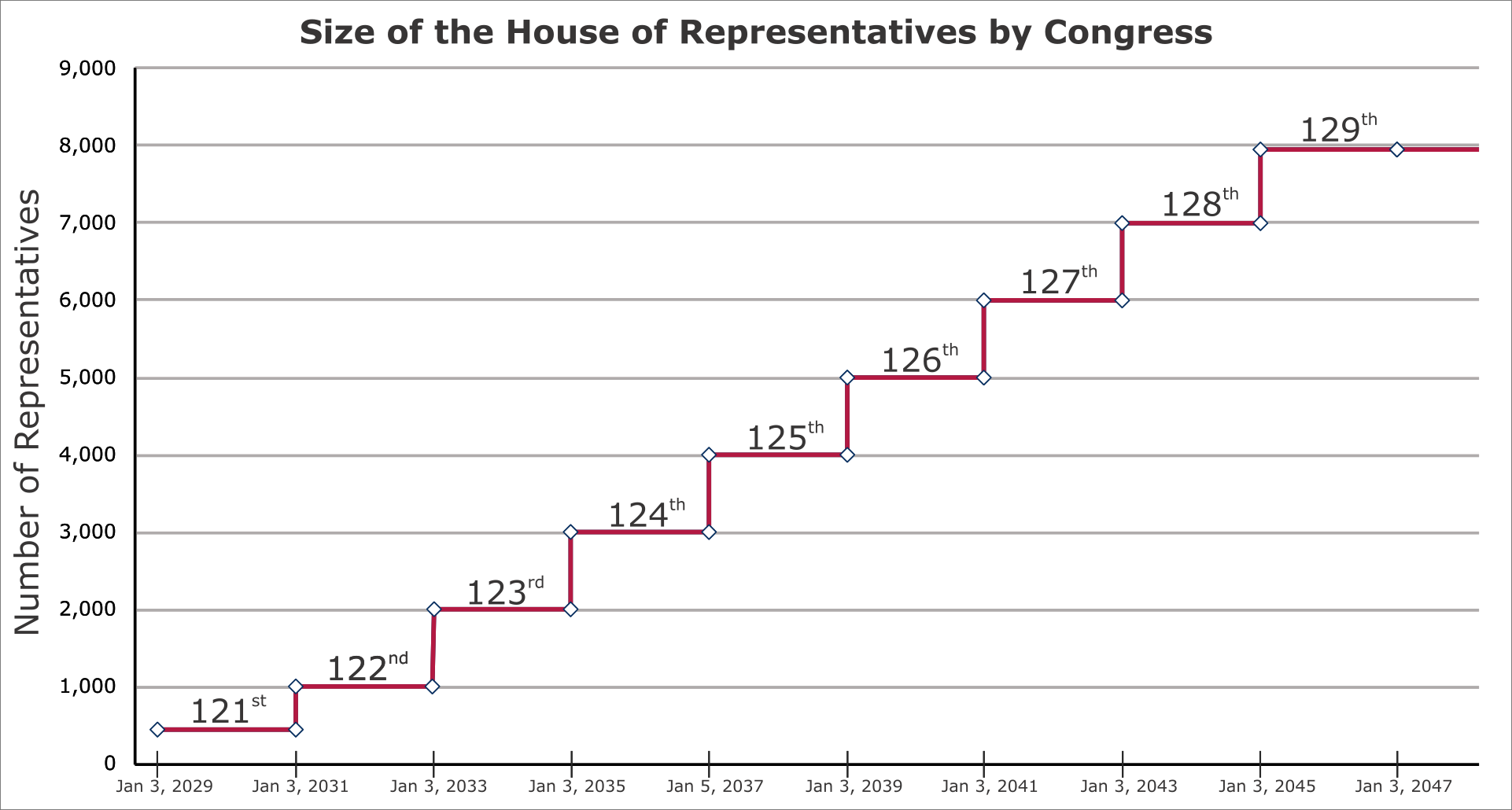
Illustration from The House of Representatives is Scalable.
In contrast, the bill’s recurring recalculation creates the illusion of continued progress, because the number of seats gradually climbs, but whatever quality of representation a citizen would actually feel is frozen on the day the first apportionment occurs under the bill.
Consider whose problem the bill solves. Reducing the average constituency from 760,000 to 500,000 is a real and legitimate benefit — to the Representative, whose caseload, staff burden, and campaign expenses all shrink. But that is a gain to the office, not to the citizen. From the perspective of the people living in these massively populated districts, almost nothing changes: The odds of ever meeting your member, of your vote proving decisive, of being known rather than polled, move from negligible to slightly-less-negligible. These huge districts are still far too large for the “know and be known” relationship the Framers had in mind. Reforms that originate inside the House are naturally measured in the representative’s currency, because that is the burden a sitting member feels; but the House exists for the benefit of the represented, not for the convenience of the political ruling class.
That gap between what the bill does for the office and what it does for the citizen is the seed of a real danger. A change too small for the public to feel invites a damaging conclusion. If the House is enlarged and nothing the citizens experience improves — if campaigns remain as expensive, districts as gerrymandered, incumbents as safe, and Washington as distant — then it hands defenders of the status quo a ready-made weapon — the argument they could never make before: We tried a bigger House, and it changed nothing, so size was never the problem. A modest, unfelt expansion does not advance the cause of the People’s House; it risks inoculating the country against it, converting a genuine reform into a cautionary tale and breeding the resignation that nothing can be fixed. A partial solution is thus worse than no solution at all: A reform not yet tried leaves the goal alive for another day, while a partial solution that accomplishes nothing can bury it. The tragedy would be a permanently larger political class that really provides no better representation of the people — the appearance of reform without its substance.
The Method: Why Electoral Reform Should Not Ride Along
One fact about the bill deserves emphasis, because its framing obscures it. The measure is discussed as “ranked-choice voting,” but the ranked ballot here is not the familiar single-winner method used in Alaska and Maine; it is the multi-winner variety, the single transferable vote, and it can operate only inside multi-member districts. Many who would welcome “ranked-choice voting” may not realize they would be adopting multi-member districts to get it — yet the bill’s own structure concedes the link, since the ranked ballot of Section 4 cannot be used without the multi-member districts of Section 3.
With that in mind, the bill’s second flaw is that it staples a genuinely contested electoral reform onto what should be a clean structural change. Creating an exception to the single-member-district requirement, and allowing multi-member districts and ranked ballots, are not incidental provisions; they are fundamental changes to how Americans choose their Representatives, and are the subject of rancorous debate.
Ranked-choice voting and multi-member districts are often presented as if they were indisputably beneficial — a modernization that no reasonable person could oppose. Their advocates point to a genuine benefit: Proportional, multi-winner elections can seat political minorities — including a dispersed minority, spread thinly across many districts — that single-winner elections shut out entirely. But that is not the whole story. At the same number of Representatives, no one has shown that multi-member districts produce better representation overall once the full range of considerations is weighed: The accessibility of a single, identifiable representative accountable to a defined community; the cost and complexity of campaigning across a larger multi-member district; and the transparency of the count itself, since multi-winner tabulation is far harder for an ordinary voter to follow and verify than a simple tally. These are not fringe complaints; they are the reason thoughtful people disagree, and the reason multi-member districts and ranked voting remain contested rather than settled. Thirty-Thousand.org provides a deeper evaluation of this question in this essay.
This is why the bundling matters, and the argument requires no verdict on the merits at all. Even those who support ranked-choice voting and multi-member districts should hesitate to see them bundled into this bill. Enlarging the House is a structural, non-partisan reform grounded in the Framers’ design — the rare goal capable of uniting people across the political spectrum. A contested electoral overhaul is not. Fastening the two together does two kinds of damage. It puts the enlargement at risk, because anyone who objects to the electoral changes now has reason to oppose the entire package. And it taints the motive behind the enlargement itself: A clean structural reform, arriving bolted to an electoral-method change that carries a partisan charge, invites the suspicion that a larger House was never the real aim but merely the vehicle.
And saying that it is merely “optional” to implement multi-member districts is somewhat misleading: The multi-member provision would actually create an exception to the national single-member-district standard that has held since 1967. Whatever one concludes about the merits, a reform this contested should not be combined with the one that ought to unite everyone.
A Third Concern: The Commission’s Discretion
The bill’s fifth section creates a commission that activates only when the formula would change the size of the House by 15 percent or more from one census to the next. This is a high bar. Because House size tracks population under the formula, a 15 percent swing in seats requires roughly a 15 percent swing in population between censuses — something the United States has not seen since the 1950s, with recent decades running near 7 percent. So the commission would seldom, if ever, activate, and in an ordinary decade the formula runs automatically, leaving no discretion at all.
But if the commission were to activate, its role is more consequential than “administrative” suggests. The statute directs it to recommend not the formula’s mechanical output but the “optimal” number of Representatives and their apportionment, weighing population shifts and the reduction of district-size disparities — so in the very decade population shifts most, the bill invites a body to propose a House size different from what the formula would produce. The commission can only recommend; Congress must still enact any departure. But that is the worry, not the reassurance.
The panel is appointed in balanced fashion by both parties’ leaders in both chambers and charged by statute to act “in a nonpartisan manner” — and a recommendation carrying that nonpartisan imprimatur is exactly what a controlling congressional majority could invoke to justify enacting whichever size serves it, the kind of cover a naked lever could never provide. Unified control of both chambers, which one party or the other frequently holds and does today, is when that temptation would be greatest. A quieter risk lurks as well: The 1929 apportionment law this bill amends was written to make apportionment automatic, precisely so that Congress could not refuse to reapportion the House as it did after the 1920 census. Based on our reading, that automatic apportionment would still proceed on its own; but the bill does not say what happens in a large-swing decade if the commission recommends a different number and Congress then does nothing — leaving, at the margin, room for the very stalemate the 1929 law was meant to foreclose.
What Thirty-Thousand.org Would Support
We have spent two decades arguing that the House must grow substantially, far more than this bill contemplates. What we would support is a clean enlargement anchored to achieving true equality of our voices rather than an arbitrary number; that is, a House sized to approach the constitutional standard of equal representation, growing in managed steps toward the much smaller districts that make a Representative knowable to the people represented. In short: the staircase, not the plateau.
Conclusion
The Equal Voices Act would enlarge the House to a modest extent, but the citizenry would not feel any better represented by the House than it does today. Gerrymandering would continue; campaigns would remain expensive; districts would remain grossly unequal; incumbents would remain safe. The country would have a larger permanent political class, most of it still concentrated in Washington, rather than working from the districts it represents, and a public with less reason than ever to believe that the size of the House was ever the point. That is the real hazard of a reform too small to be felt: not that it does harm, but that it teaches the wrong lesson, and leaves behind the resignation that the republic cannot be made more representative no matter what is tried.
The result of the bill’s modest increase would simply be to add more career politicians, whereas enlarging the House into the thousands would replace them with citizen legislators who answer to neighbors rather than donors.
The Framers anticipated that Congress may eventually fail to ensure that the House grew proportionately with the total population, which they believed was essential for a small republic to scale up successfully as the country grew. That is why the intended version of “Article the first”, the constitutional amendment proposed by congress in 1789, was written to keep congressional districts small as the nation grew. They expected a chamber of many hundreds, eventually thousands, of Representatives close enough to their constituents to be known by them. That vision is not a fringe idea; it is the Founders’ intended design.
Thirty-Thousand.org will back the proposals that move the country toward that goal — and will measure each against the same standard a genuine enlargement must meet.8As of this writing, House enlargement appears in only a small number of measures before the 119th Congress. The most concrete is H.R. 4125; the other, H.R. 2797 (the House Expansion Commission Act), would establish a commission to study expansion rather than enact it. Neither has advanced beyond referral to committee. The Equal Voices Act does not meet it: It picks an arbitrary number that leaves voters egregiously unequal, bundles in an electoral overhaul that should stand on its own, and hands a commission discretion better left out of reach, all under a name that promises the one thing it does not deliver. It will not be the last half-measure to arrive dressed as reform. Each should be judged not by the direction it points but by whether it travels far enough to be felt — because a step too small to feel is not a step toward the People’s House. Instead it closes the door on progress.
© Thirty-Thousand.org (published 08/02/2026)


- 1Though the odd-number rule is meant to avert tie votes, the text does not say how to resolve the count when the division lands on an even number and the two nearest odd numbers are equally close — a small ambiguity that could itself decide a seat, and one any state hoping for that extra Representative would be entitled to contest. For the 2020 census the result is unambiguous: 331,108,434 ÷ 500,000 = 662.2, whose nearest odd number is 663. As of this writing, the sponsor’s online summary materials describe a different formulation (population divided by the population of the least populous state) and a larger figure (about 689 seats); this article follows the operative text of the introduced bill, which specifies division by 500,000. Note that 500,000 is the divisor the bill applies, not the average district it produces: At 663 seats the actual national average is 331,108,434 ÷ 663 = 499,409. ↩︎
- 22 U.S.C. § 2c, enacted as part of the Uniform Congressional District Act of 1967, requires that Representatives be elected from single-member districts. H.R. 4125 does not repeal this requirement; Section 3 amends it to add a conditional exception (“Except as provided in section 2(b) of the Equal Voices Act …”), so single-member districts remain the default for any state that does not affirmatively adopt multi-member districts. ↩︎
- 3The disparity compares the most populous district with the least populous: Vermont’s 643,503 ÷ Alaska’s 368,041 = 1.748, i.e., the most populous district has 74.8% more people than the least populous. It reflects only the two extremes; the spread across all districts is the separate measure, dispersion. ↩︎
- 4The relative standard deviation, or coefficient of variation, is the standard deviation of district sizes divided by their mean, expressed as a percentage. Both figures here are computed across every one of the individual congressional districts (435 in the current House, 663 under the bill). ↩︎
- 5Enacted district populations from the U.S. Census Bureau, 2020 Census 118th Congressional District Summary File (CD118), Table P1. Congressional districts carry small Census disclosure-avoidance adjustments, which is why “equal” districts differ by a few persons rather than exactly zero. ↩︎
- 6The 0.30% figure is the apportionment of roughly 6,692 Representatives that would comply with the intended version of Article the First; for more information see: https://thirty-thousand.org/house-one-person-one-vote/ ↩︎
- 7Total-population projections for 2030, 2040, and 2050 from the University of Virginia Weldon Cooper Center for Public Service, National and 50-State Population Projections (2026 vintage). These are used as a plausible illustration, not a forecast; the plateau is a structural property of fixing the divisor at 500,000, so any reasonable growth path produces the same result. The 2020 row uses the official apportionment population (331,108,434) and reproduces the enacted apportionment exactly; the projection rows use resident-population projections, since no apportionment-population projection exists. The difference is about one-tenth of one percent of the national total and does not affect the trend. ↩︎
- 8As of this writing, House enlargement appears in only a small number of measures before the 119th Congress. The most concrete is H.R. 4125; the other, H.R. 2797 (the House Expansion Commission Act), would establish a commission to study expansion rather than enact it. Neither has advanced beyond referral to committee. ↩︎