SUPPLEMENTAL CONTENT
Free Versus Slave States Circa 1789:
A Seething Cultural Divide
The states’ perspectives on slavery was another factor that influenced how their legislatures viewed Article the first.
DRAFT FOR COMMENT POSTED ON June 15, 2025.
This essay examines the following three characteristics that generally distinguished the free states from the slave states in the late 1780s:
- Whether or not the states’ delegates at the Constitutional Convention owned slaves, along with their stances on slavery.
- Whether the state was enacting or implementing any prohibitions against slavery.
- The number of enslaved people, if any, residing within each of these states.
Relative to the subject of Article the first, the relevance of this issue has to do with how these states viewed the proposed constitutional amendment that was intended to compel the size of the House to grow proportionately with the total population, given that those states with the largest slave populations were expected to experience the largest rates of growth.
North versus South
The rift between the free and slave states was marked by a very specific cartographical boundary. During the 1760s, a territorial dispute between Pennsylvania and Maryland was permanently settled by establishing a common boundary known as the Mason-Dixon Line. Relative to the subject of slavery, this became a convenient delineation: All the “free states” were to the north of that line, and the “slave states” were those to the south. This geographical dichotomy is illustrated in the adjacent map (which does not include the states’ territorial claims to the west).
However, given that a relatively small number of enslaved people were residing north of the Mason Dixon line, why should those states be considered “free”? That question is answered in this essay, but the underlying structural difference is that the states north of the Mason-Dixon Line were in the process of eliminating slavery, whereas the southern states were staunchly committed to institutionalizing it.
Delegates to the Constitutional Convention
There were 55 delegates who participated in the drafting of the Constitution during the convention in 1787.1National Archives: Meet the Framers of the Constitution Of those, it has been estimated that 25 owned slaves,2McDonald, Forrest. 1958. We the People: The Economic Origins of the Constitution. Chicago, University of Chicago Press, 68-85 which is a commonly cited figure. However, because there does not appear to be any detailed records to support that estimate, an analysis was undertaken by Thirty-Thousand.org to determine which delegates from each state were likely to have been slave owners. According to that analysis, 30 of the 55 delegates were likely to have owned slaves.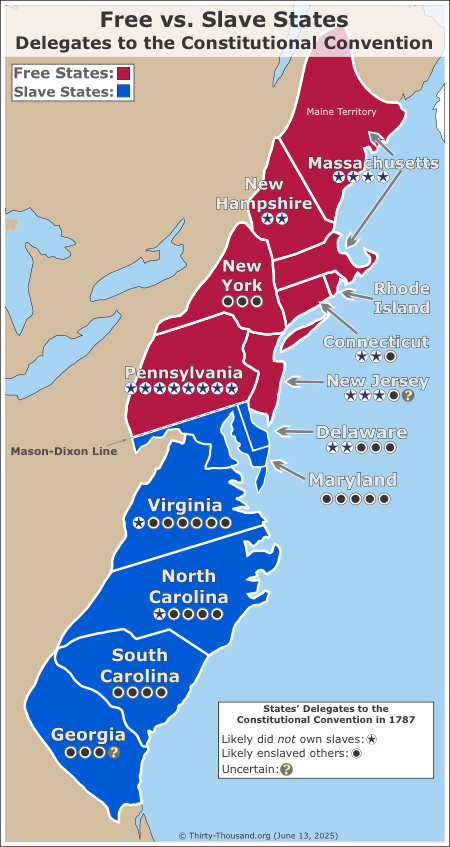
Based on that information, a table summarizing the delegates’ status relative to slave ownership, along with their stances on same, is provided in the exhibit at the end of this essay. The adjacent map indicates, for each state, delegates who owned slaves at the time of the convention with this symbol: ⦿. Those who did not own slaves at that time are indicated by this symbol: ✪. And any who could not be determined are indicated with a “?”.
As expected, there was a much higher proportion of slave owners identified in the southern states (83%) than in the northern ones (20%). Just as importantly, the southern delegates tended to own a large number of slaves and often were actively involved in perpetuating slavery. In contrast, those northern delegates who owned slaves usually owned very few, and often expressed misgivings about doing so.
Of course, it cannot be assumed that all of those who did not own slaves adamantly opposed slavery. Likewise, of those who did own slaves, it cannot be assumed that all of them embraced slavery. For example, George Washington stated that “there is not a man living who wishes more sincerely than I do, to see a plan adopted for the abolition of it”.3National Archives: Letter from George Washington to Robert Morris, 12 April 1786 And at least one former slaveowner, Benjamin Franklin, had become an active abolitionist by the time of the convention.4For additional information on the sentiments of many of the delegates with respect to slavery, see the full report referenced in the appendix to this report. For obvious reasons, this was a profound moral dilemma for many of these men.
For many of the slaveowners, the institution of slavery was something they were born into, and they didn’t know how to compete commercially without slavery unless it were abolished everywhere at the same time. Only a national government could ever bring about such an abolition, and these delegates who were gathered in Philadelphia formed such a government. Relative to the brutal reality of slavery, that was the context in which our Constitution was drafted.
The Demographics of Slavery
If the northern and southern states are each viewed in the aggregate, the contrast relative to slavery is so striking that they are analogous to a single nation that has split into two starkly antithetical countries (like East vs West Germany). The extent of this contrast, which extends to the constituent states that comprise each of these two hypothetical nations, is revealed by the 1790 census data.
The map below illustrates how the United States appeared in 1790, including the states’ territorial claims to the west, when that census was taken.
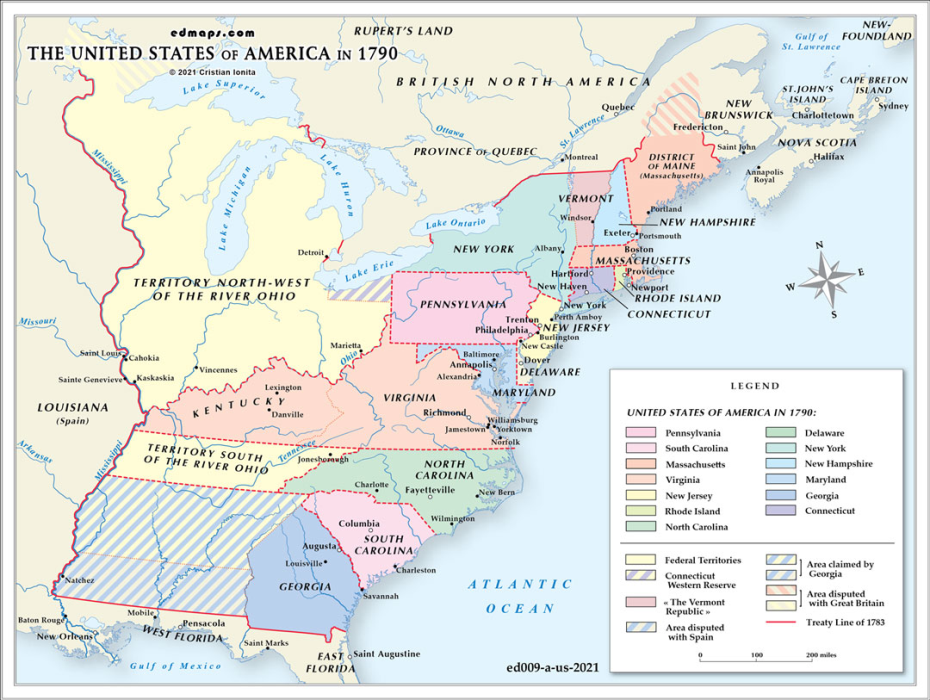
Map: © Cristian Ionita edmaps.com
In 1790, three years after the Constitution was proposed, America’s first census was conducted on the 13 original states plus three prospective states: Vermont, Kentucky, and Maine. Those three states were subsequently admitted to the Union on the following dates:
• Vermont — March 4, 1791 (from New Hampshire)
• Kentucky June 1, 1792 (from Virginia)
• Maine March 15, 1820 (from Massachusetts)
As shown in the map above, those three prospective states were still within the territorial claims of the original states when the census was conducted. Therefore, this analysis merges those states’ census data into their respective progenitor states. This provides a reasonable estimation of the percentage of each state’s population that was enslaved around the time the Constitution was drafted (1787) and ratified (1789).
Based on that premise, the total population of the free states (1,968,154) was nearly equal to that of the southern slave states (1,925,483). This is illustrated by the pie charts below, wherein the upper red section represents the states north of the Mason-Dixon line, and the lower blue section represents the southern slave states.
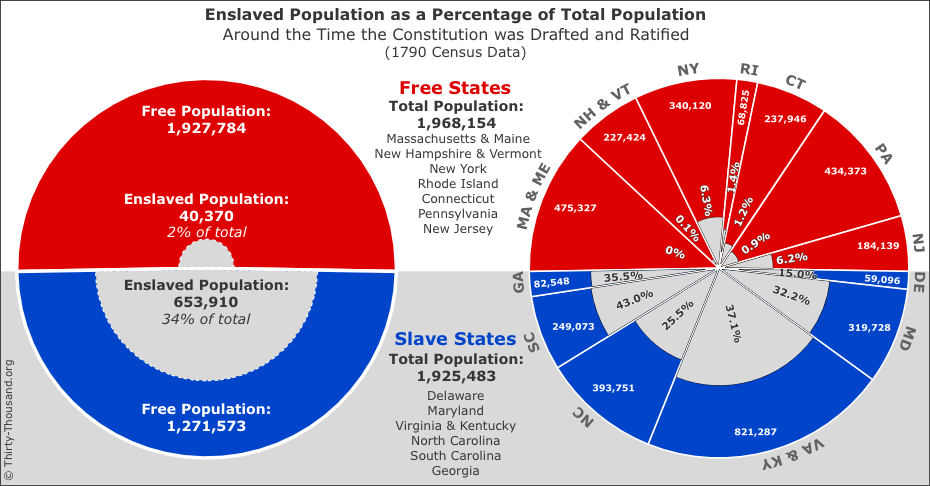
The portion of the population which was enslaved is indicated by the light gray areas in both pie charts. As shown by the chart on the left, 34% of the population of the southern states was enslaved. In contrast, only 2% of the northern states’ population was enslaved. As a result, 94% of all the enslaved people in the U.S. were located south of the Mason-Dixon line, with the remaining ones in the northern states.
Note that, as indicated by the pie chart to the left, the free states had 1,927,784 free people versus 1,271,573 in the slave states. In other words, the northern states had 51% more free people than did the south. This is an essential point relative to understanding how the citizens of the northern states would view the allocation of representation between themselves and the southern states.
The pie chart to the right extends this analysis by indicating, for each state, its total population and the percentage thereof enslaved. As would be expected, enslaved people comprised relatively small percentages of the northern states’ populations, ranging from zero in Massachusetts to 6.3% in New York. In contrast, south of the Mason Dixon line the, the enslaved population ranges from 15% in Delaware to 43% in South Carolina.
Though this census data was not available when the Constitution was developed and ratified, it stands to reason that many of the states’ leaders were generally cognizant of the relative magnitudes of the states’ demographics. In fact, the aggregate population estimates upon which Federalist 55’s projections were derived (in February of 1778) were approximately correct, as confirmed by the subsequent census.
Given that, with respect to the expected distribution of representation in a proportionally apportioned House, it’s easy to imagine the apprehension felt by the free states, especially the geographically smaller free states!
Prohibitions Against Slavery
The presence of any enslaved people in the northern states may seem to belie the assertion that those states can be called “free”; however, there are two mitigating factors that must be considered. First, it cannot be assumed that all of those who were counted as slaves in the free states were enslaved by citizens of those states. It was not unusual for wealthy southern slaveowners to travel to the northern states for temporary stays, either for business or personal reasons, and bring their slaves with them to assist with work or perform domestic duties. Typically, this occurred during the summer months to escape the south’s sweltering climate. This timing is relevant as, in the northern states, the census began in early August of 1790 and usually was not completed until later that fall.
At this time in history, the northern states could not have implemented any measures to prevent the citizens of other sovereign states from bringing their human “property” with them; however, they were in the process of enacting and implementing prohibitions against slavery, which leads to the next point.
The second, and more significant, point is that the northern states’ general abhorrence of slavery is clearly demonstrated by their ongoing efforts either to prohibit or phase out slavery via constitutional, legislative or judicial prohibitions.
- Massachusetts: From 1781 to 1783, in three related cases, the state’s Supreme Judicial Court effectively abolished slavery by declaring it incompatible with the newly adopted state constitution. Massachusetts, which then included Maine, had the distinction of have absolutely no enslaved people counted in the 1790 census.
- New Hampshire: The state’s 1783 state constitution declared “all men are born equal and independent,” with natural rights, “among which are enjoying and defending life and liberty.”5New Hampshire Bill of Rights, October 1783 This was similar to the language that led to the end of slavery in Massachusetts. However, there were no specific prohibitions against slavery, and 158 enslaved persons were counted in the 1790 census.
- Rhode Island: A 1652 law made it illegal for any person to be “bound” longer than ten years, and another in 1675 forbade the enslavement of Indians. These laws were widely ignored. In 1784, the state’s General Assembly passed the Gradual Emancipation Act. According to this act, children born to slaves would not remain slaves and masters could manumit healthy slaves between the ages of 21 and 40 without assuming financial responsibility. It is this gradual emancipation that would account for the 948 enslaved people included in the 1790 census.
- Connecticut: An act of Gradual Abolition was passed in 1784, stating that those born into slavery after March 1, 1784 would be freed by the time they turned 25. As a result, slavery was practiced until 1848.
- New York: A Gradual Emancipation act was passed in 1799 freeing slave children born after July 4, 1799, but indentured them until they were young adults. In 1817 a new law passed that would free slaves born before 1799, but not until 1827.
- Pennsylvania: The Gradual Abolition Act of 1780 gradually emancipated enslaved people without making slavery immediately illegal. The act permitted slaveholders to keep the enslaved individuals they already owned unless they failed to register them annually. At the same time, the act provided for the eventual freedom of individuals who were newly born into slavery.
- New Jersey: The last northern state to begin the process of ending slavery, passed a law in 1804 for the “gradual emancipation of slaves”.
The northern states’ prohibitions against slavery may seem imperfect from a modern perspective, especially relative to the three northern states that enacted abolitionist prohibitions after the Constitution was ratified; However, these efforts demonstrate that, around the time the Constitution was drafted, the citizens of the northern states were largely opposed to slavery. This stands in stark contrast to the six southern states’ persistent commitment to the institution of slavery.
- Virginia, North Carolina, South Carolina and Georgia confederated with seven other states, in 1861, to launch a war to secede from Union in order to protect their slave-based economies.
- Maryland finally prohibited slavery in October of 1864 when they ratified a new constitution (shortly after Union forces captured Atlanta, and five months before the Civil War ended).
- Delaware maintained slavery until 1865 when the 13th Amendment was ratified to the Constitution (which Delaware itself did not ratify until 1901).
To summarize, while the citizens of the northern states were generally opposed to slavery, as evidenced by their legislative and judicial efforts to eliminate it, the southern states were staunchly committed to preserving it.
The Seething Cultural Divide
By 1787, the institutionalization of slavery in the southern states had long been the basis of a seething cultural divide with the northern states. This is reflected in an observation made by Caleb Strong at the Massachusetts ratification convention: “The southern States have their inconveniences; none but negroes can work there; the buildings are worth nothing.”6The Records of the Federal Convention of 1787. (Farrand’s Records, Volume 3.) CLXXVI. Caleb Strong in the Massachusetts Convention, January 18, 1788. And Melancton Smith complained bitterly at the New York ratification convention about “those people who were so wicked as to keep slaves”.7Francis Childs’ Notes of the New York Ratification Debates (June 20, 1788)
This deep cultural divide relative to the formation of the nation is clearly evident from the delegates that were sent to the Constitutional Convention relative to whether they owned slaves, the fact that at least 96% of the enslaved people lived in the southern states, and the ongoing efforts by the northern states to prohibit slavery.
However, time would reveal that this was more than just a cultural divide: It was a timebomb. Because this was the first truly national government created by the states, it would take another 78 years before this festering antagonism is settled. It will eventually require over 700,000 battlefield deaths,8Hacker, J. David. “A census-based count of the civil war dead.” Civil War History, vol. 57, no. 4, Dec. 2011, pp. 307+. Gale Academic OneFile plus hundreds of thousands of other casualties, to finally bring an end to slavery across the nation.
Acknowledgement goes to Audrey Woodward for conducting a substantial amount of primary research, relative to the delegates to the Constitutional Convention, which was used to inform the analysis used for this report.
Appendix
Because we could not locate sufficient historical references on many of the delegates relative to whether they owned slaves, we utilized Google Gemini’s “Deep Research” capability to supplement our effort. The development of the determinations as to which delegates owned slaves is a result of an iterative discussion with Gemini, in which we would present our primary research in those cases where there were discrepancies between our findings and Gemini’s. The final report used for this essay can be viewed here. Though Gemini’s report appears to be fairly exhaustive, it could be improved upon with the application of additional academic rigor in combination with accessing historical resources that were unknown to us and unavailable to Gemini. That not withstanding, this summary should provide a very good approximation of the status of the delegates, relative to slavery, at the time of the convention.
Thirty-Thousand.org/Gemini Joint Analysis Summary
The textual content in the table below was provided by Gemini.
| State | Delegate Name | Owned Slaves? | Slave ownership summary | Key Stance/Action on Slavery circa 1787 |
| CT | Oliver Ellsworth | No | Explicitly stated he “never owned a slave”; from Connecticut, which had provision for abolishing slavery. |
Believed slavery would eventually diminish; advised against federal intervention, leaving it to states. |
| CT | William Samuel Johnson | Yes | At least 20 enslaved people mentioned in correspondence | Owned slaves in 1787; opposed slavery and supported abolition. |
| CT | Roger Sherman |
No | 1790 Census shows no slaves; described as an opponent of slavery who sought to prevent Southern states from gaining political power through slave representation. | Opposed slavery personally; disapproved of the slave trade but prioritized union; advocated for counting only free inhabitants for representation. |
| DE | Richard Bassett | No | Owned slaves at the start of 1787; freed his slaves after converting to Methodism in 1787. | Campaigned for abolition in Delaware. |
| DE | John Dickinson | No | Manumitted all his slaves in 1786. | Opposed any constitutional authorization of slave importation. |
| DE | Gunning Bedford Jr. | Yes | Slave owner (listed as such) | Owned slaves in 1787; was a leading advocate for the abolition of slavery. |
| DE | Jacob Broom | Yes | One slave (according to later census) | Owned one slave in 1787 despite signing an abolition petition. |
| DE | George Read | Yes | Slaveholder | Owned slaves in 1787; explicitly described as a slave owner in historical records. |
| GA | Abraham Baldwin | ? | Not definitively known; some speculation he did not own slaves, though one source refers to him as an “enslaver.” | Disapproved of slave trade; voted for prohibition of slavery in Northwest Territory; but argued slavery was a “local nature” issue for Georgia. |
| GA | William Few | Yes | Owned slaves (other historical sources confirm) | Owned slaves in 1787; voted for prohibition of slavery in Northwest Territory (a vote against its expansion). |
| GA | William Houstoun | Yes | Planter and slave owner | Owned slaves in 1787. |
| GA | William Pierce | Yes | Planter and slave owner | Owned slaves in 1787; explicitly stated as a “planter and slave owner.” |
| MD | Daniel Carroll | Yes | Nearly 300 | Owned slaves in 1787; acknowledged slavery as “a great evil.” |
| MD | Daniel of St. Thomas Jenifer | Yes | 78-80 (in 1798/1811, implying ownership in 1787) | Owned slaves in 1787. |
| MD | Luther Martin | Yes | Owned six people | Owned slaves; argued slave trade was “inconsistent with principles of the revolution” and should be federally regulated. |
| MD | James McHenry | Yes | 10 at death (1818, implying ownership in 1787) | Owned slaves in 1787. |
| MD | John Francis Mercer | Yes | Operated estates using enslaved labor (from 1785) | Owned slaves in 1787; later voted against the Fugitive Slave Act of 1793. |
| MA | Elbridge Gerry | No | Listed as non-slaveholder; Massachusetts had effectively abolished slavery by 1783. | Opposed Three-Fifths Compromise and slavery itself. |
| MA | Nathaniel Gorham | No | No evidence of direct slave ownership in provided sources; from Massachusetts, which had effectively abolished slavery. | Pragmatic; focused on economic implications for Massachusetts. |
| MA | Rufus King | No | Massachusetts had effectively abolished slavery by 1783; consistently opposed the expansion of slavery. |
Strong anti-slavery; found slave representation “grating”; argued slavery made nation less secure. |
| MA | Caleb Strong | No | Described as an abolitionist; Massachusetts had effectively abolished slavery by 1783. | Personal stance was abolitionist; from a state with effective abolition. |
| NH | Nicholas Gilman | No | 1790 New Hampshire census shows no slaves. While some sources claim he owned a slave named Peter, the direct census data for 1790 indicates no ownership. | Voted for act prohibiting slavery in northwestern United States (a vote against expansion). |
| NH | John Langdon | No | Grew up in a slave-owning family, but likely never inherited slaves or had already emancipated them; treated enslaved individuals as paid domestic servants by 1783. | Wanted Congress to have power to ban the slave trade, not trusting Southern states to do so voluntarily. |
| NJ | David Brearly | ? | Slave owner (conflicting info; some sources list him, others don’t explicitly confirm 1787 ownership with detail) | Listed as a slave owner in some sources, but specific details or counter-evidence not provided. |
| NJ | Jonathan Dayton | Yes | Slave owner | Owned slaves in 1787; supported toleration of slavery in new territories. |
| NJ | William Churchill Houston | No | No evidence of direct slave ownership in provided sources. A book claims he owned slaves, but there is no census data for 1790 in New Jersey to corroborate. | Expressed opposition to slavery; recommended heavy taxation on slavery. |
| NJ | William Livingston | No | Owned slaves at the start of 1787; freed Bell and Lambert in 1787. | Member of New York Manumission Society; tried to pass emancipation laws in New Jersey. |
| NJ | William Paterson | No | No evidence of direct slave ownership in provided sources. | Pointed out the “shame” associated with the term “slaves” in the Articles of Confederation. |
| NY | Alexander Hamilton | Yes | Purchased for self/others; family had enslaved servants | Evidence suggests he purchased enslaved people for himself and others, despite being a prominent member of an anti-slavery society. |
| NY | John Lansing Jr. | Yes | Handful of household slaves |
Owned a handful of household slaves in 1787. |
| NY | Robert Yates | Yes | Small number of house slaves | Owned a small number of house slaves in 1787. |
| NC | William Blount | Yes | Owned slaves, large land speculator | Owned slaves in 1787; a planter and land speculator. Documented ownership of at least 26 enslaved people by 1797. |
| NC | William Richardson Davie | Yes | Slave owner | Owned slaves in 1787; helped shape the Three-Fifths Compromise. |
| NC | Alexander Martin | Yes | Slave owner (listed as such) | Owned slaves in 1787. |
| NC | Richard Dobbs Spaight | Yes | 71 in 1790, 89 at death (implies ownership in 1787); extensive enslaver | Owned slaves in 1787; led efforts to remove Jefferson’s proposed ban on slavery from Northwest Ordinance (indicating support for perpetuation). |
| NC | Hugh Williamson | No | Explicitly stated as “not an enslaver.” | Prioritized Union over abolition; argued NC would not join Union if slave trade banned. |
| PA | George Clymer | No | Inherited one enslaved person as a child (age 7) who died shortly after; no direct ownership in 1787. | Actively opposed slave trade; unsuccessfully attempted to regulate slave importation; supported an “export tax” (indirectly taxing slavery). |
| PA | Thomas Fitzsimons | No | Owned slaves, but freed them in 1784. | Vocal proponent of abolishing the slave trade; advocated for strong national government powers that could discourage slavery. |
| PA | Benjamin Franklin | No | Former slaveholder; became president of Pennsylvania Society for Promoting the Abolition of Slavery in 1787. | Vocal abolitionist; submitted petition to Congress for abolition. |
| PA | Jared Ingersoll | No | 1790 Pennsylvania Census shows he owned no slaves. Conflicting information from a prior source stated he owned three slaves. | Opposed slavery; was a delegate to the Federal Convention but took little part in its deliberations. |
| PA | Gouverneur Morris | No | No evidence of direct slave ownership in provided sources. | Outspoken opponent of slavery; condemned it as “nefarious institution.” |
| PA | Robert Morris | No | Did not personally own slaves in 1787, but owned a slave ship and invested in slave-operated plantations (indirect financial interest). | “Borderline case” due to indirect participation in slave trade; no direct advocacy against slavery mentioned in provided sources. |
| PA | Thomas Mifflin | No | Manumitted all his slaves in 1774-1775. | Active anti-slavery advocate; helped pass anti-slavery legislation in Delaware in 1787. |
| PA | James Wilson | No | 1790 Pennsylvania Census shows he owned no slaves. While Wikipedia previously claimed he owned one household slave, this is not supported by the 1790 census. | Opposed explicit recognition of “property in man” in Constitution; a principal architect of the executive branch and supporter of proportional representation. |
| SC | Pierce Butler | Yes | Prominent slave owner and advocate for slavery protections. | Owned slaves; strongly advocated for the Fugitive Slave Clause and protection of slave property. |
| SC | Charles Pinckney (The younger cousin) | Yes | Plantation owner, slaveholder (hundreds) | Owned slaves; staunch defender of slavery; insisted SC would not join Union if slave trade prohibited; argued for counting enslaved people fully. |
| SC | Charles Cotesworth Pinckney | Yes | Approx. 250 in 1801 (implies ownership in 1787) | Owned slaves; believed slavery necessary for SC economy; agreed to 1808 slave trade ban but opposed emancipation. |
| SC | John Rutledge | Yes | 28 after Revolution, 1 at death (1800) (implies ownership in 1787) | Owned slaves; asserted “Religion and humanity have nothing to do with this question” regarding slave trade; key in preventing abolition. |
| VA | John Blair | Yes | Owned several slaves; inherited slaves | Owned slaves in 1787; a slaveholder and farmer. |
| VA | James Madison | Yes | Over 100 at Montpelier | Owned slaves; expressed moral qualms, supported manumission legislation and colonization, but never freed his own slaves in his lifetime. |
| VA | George Mason | Yes | Hundreds of slaves | Owned slaves; spoke strongly against slavery and the slave trade, calling it an “infernal traffic”; refused to sign Constitution partly due to slavery protections. |
| VA | James McClurg | Yes | Believed to have owned slaves | Believed to have owned slaves in 1787. |
| VA | Edmund Randolph | Yes | Slave owner | Owned slaves in 1787; seconded motion to tax imported slaves, suggesting a pragmatic approach to the trade. |
| VA | George Washington | Yes | Hundreds at Mount Vernon | Owned slaves; became hostile to slavery, wished for legislative abolition; freed all enslaved people in his will (after 1787). |
| VA | George Wythe | No | Owned 9 “blacks” according to 1782-85 Virginia Census. Transferred ownership of 11 slaves in October 1787, and freed his last three slaves in 1788. While some accounts mention a “deathbed” manumission, earlier actions are documented. | Argued publicly and privately against slavery; urged emancipation. |
© Thirty-Thousand.org June 19, 2025

- 1National Archives: Meet the Framers of the Constitution ↩︎
- 2McDonald, Forrest. 1958. We the People: The Economic Origins of the Constitution. Chicago, University of Chicago Press, 68-85 ↩︎
- 3National Archives: Letter from George Washington to Robert Morris, 12 April 1786 ↩︎
- 4For additional information on the sentiments of many of the delegates with respect to slavery, see the full report referenced in the appendix to this report. ↩︎
- 5New Hampshire Bill of Rights, October 1783 ↩︎
- 6The Records of the Federal Convention of 1787. (Farrand’s Records, Volume 3.) CLXXVI. Caleb Strong in the Massachusetts Convention, January 18, 1788. ↩︎
- 7Francis Childs’ Notes of the New York Ratification Debates (June 20, 1788) ↩︎
- 8Hacker, J. David. “A census-based count of the civil war dead.” Civil War History, vol. 57, no. 4, Dec. 2011, pp. 307+. Gale Academic OneFile ↩︎