SUPPLEMENTAL CONTENT
Mr. Ellsworth’s “Last Line But One”
By replacing the fourth instance of the word “less” with the word “more” in the intended version of “Article the first”, the clerks in Congress did exactly as they were instructed. Replacing any other instance of the word “less” would have created an equally nonsensical result.
DRAFT FOR COMMENT POSTED ON June 2, 2025.
Here is the mystery: Why does the very first amendment proposed for the Bill of Rights, Article the first, contain an inexplicable error in its formulation which rendered it completely ineffectual for its intended purpose? How did this fatal flaw get introduced, during the waning days of the first congress, into what was previously a perfectly coherent proposal? And how could this have possibly happened given that so many brilliant men were involved with its development? This is a bewildering mystery which has inspired some rather creative theories, one of which is addressed below. But first, a quick review.
On September 21, 1789, Congress formed a Conference Committee to reconcile the remaining differences between the House and Senate with respect to the constitutional amendments which would later become known as the Bill of Rights. This committee was comprised of James Madison and two other members of the House, and Oliver Ellsworth along with two other Senators. Relative to the Conference Committee’s recommendations, the historical record provides two reports that were phrased slightly differently: One submitted by Mr. Madison to the House on September 23, 1789, and another submitted the following day by Mr. Ellsworth to the Senate.
With respect to the alteration to be made to Article the first, Mr. Madison proposed “striking out the word ‘less’ in the last place of the said article”, as shown below.

The excerpt above is from September 24, 1789, of the House Journal, when Mr. Madison’s report was recorded.
Mr. Ellsworth’s wording was slightly different, recommending “striking out the word ‘less,’ in the last line but one”, as shown below.

The excerpt above is from September 24 of the Senate Journal. It is worth noting that Mr. Ellsworth’s report as recorded in the Senate’s journal is identical to his handwritten Conference Committee report.
Not surprisingly, the instructions provided by Messrs. Madison and Ellsworth mean exactly the same thing: Replace the final instance of “less” with “more”.
Why is this important? Because the word “less” appears four times in the intended version of the proposed amendment, we want to be certain which “less” was supposed to be replaced by “more”. And whereas Mr. Madison’s instruction clearly references the final instance, a misinterpretation of Mr. Ellsworth’s statement could suggest that a different instance of “less” was to be replaced by “more”.
How could Mr. Ellsworth’s statement be misinterpreted? As explained below, it has been hypothesized that that Mr. Ellsworth’s instruction was actually referring to replacing the second instance of the word “less”, rather than the final instance; however, because of a “scrivener’s error”, the final instance of “less” was inadvertently replaced instead. Such a theory requires disregarding the following facts:
- Mr. Madison’s clear instruction to replace the final instance of “less” with “more”;
- The well established meaning of the expression “last line but one”; and,
- The mathematical absurdity that such an alteration would have created.
Mr. Madison’s instruction
Mr. Madison’s instruction (reproduced above) to strike out “the word ‘less’ in the last place of the said article” is unambiguous. It was clearly referring to the fourth and final instance of “less”. Moreover, it is highly likely that Mr. Madison himself would have overseen the engrossment of the resolution by the Clerk of the House to ensure his instructions were correctly executed.
Last line but one
The expression used by Mr. Ellsworth, “last line but one”, is unfamiliar to modern ears. What exactly does it mean? It means, as would be expected, “the one before the final one”, or “second to last”, or “penultimate”. In this context, it is referring to the last line of text before the final line, relative to a specific block of typeset text.
In order to confirm that this was the intended meaning of “the last line but one”, we can examine how this exact expression has been used historically. To that end, the following work was examined: “The Treaties and Conventions Concluded Between the United States of America and Other powers since July 4, 1776” (Revised Edition), which was Published by the Government Printing Office, 1873. Its Appendix1“The Treaties and Conventions Concluded Between the United States of America and Other powers since July 4, 1776” (Revised Edition). Government Printing Office. 1873. (Page 903 – 922) contains the “Corrections of Typographical and Other Errors” which should be made to the text contained in the body of the work. In the Appendix, the expression “last line but one” is used 14 times to identify corrections that need to be made to the original edition. In every instance, the error referenced was in the second to the last line in a specified block of typeset text.
With that in mind, when Mr. Ellsworth referred to “the last line but one”, he was referring to the second to last line of text, but of which text exactly? A month earlier, on August 25th, the Senate had ordered the printing of a hundred copies of the joint resolution proposed by the House (including its 17 proposed constitutional amendments). In 1789, that meant employing a local printer that has a mechanical press with movable type. It was printed the following day, and the resulting work can be viewed even today. It is these copies that the congressmen were referencing during their deliberations, in which the intended version of Article the first was printed as follows:
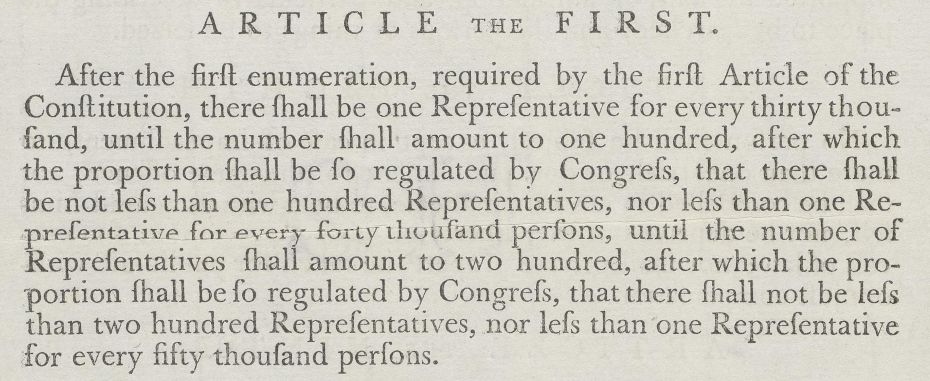
Library of Congress: James Madison Pamphlet Collection2United States Congress 1789). House, Thomas Greenleaf, James Madison Pamphlet Collection, and Printed Ephemera Collection. Congress of the United States, in the House of Representatives, Monday, 24th August: resolved, by the Senate and House of Representatives … that the following articles be proposed to the legislatures of the several states, as amendments to the Constitution. [New-York: Printed by T. Greenleaf, 1789]
Mr. Ellsworth’s reference to the “last line but one” was to the second to last line of text in the excerpt shown above. That text is repeated verbatim below, line by line (except with the archaic long s character “ſ” being replaced by “s”), with every instance of “less” embolded. The last line but one is indicated in italics:
After the first enumeration, required by the first Article of the
Constitution, there shall be one Representative for every thirty thou-
sand, until the number shall amount to one hundred. After which,
the proportion shall be so regulated by Congress, that there shall
be not less than one hundred Representatives, nor less than one Re-
presentative for every forty thousand persons, until the number of
Representatives shall amount to two hundred, after which, the pro-
portion shall be so regulated by Congress, that there shall not be less
than two hundred Representatives, nor less than one Representative
for every fifty thousand persons.
Given that the meaning of “last line but one” was well established by practice, no other interpretation is plausible. However, the alternative hypothesis is that the “last line but one” was referring to the second of the three formulaic tiers, highlighted below in italics.
After the first enumeration, required by the first Article of the
Constitution, there shall be one Representative for every thirty thou-
sand, until the number shall amount to one hundred. After which,
the proportion shall be so regulated by Congress, that there shall
be not less than one hundred Representatives, nor less than one Re-
presentative for every forty thousand persons, until the number of
Representatives shall amount to two hundred, after which, the pro-
portion shall be so regulated by Congress, that there shall not be less
than two hundred Representatives, nor less than one Representative
for every fifty thousand persons.
That hypothesis seeks to construe each of the provision’s three formulaic tiers as a “line”. As such, it deems its second tier as the “last line but one”, which would therefore require the second instance of “less” be replaced by “more” (rather than the final instance as per Mr. Madison’s Conference Committee report).
The Mathematical Absurdity
And now we turn our attention to the mathematical problem: As it turns out, replacing any instance of “less” with “more”, without making additional alterations, creates an irresolvable mathematical absurdity. Such a formulaic defect would have been discovered during the states’ ratification process, just as they eventually did relative to the defective version of Article the first submitted to them. With respect to the hypothesis in question, the resulting defect would have been nearly as problematic as that created by changing the last instance of “less” to “more”. Here’s why: Given that the first tier results in 100 Representatives once the population reaches 3,000,000, what happens when the population increases by one, to 3,000,001? Under such an alteration, there could not be more than one for every 40,000; therefore, the maximum House size would be 75. That is, the number of Representatives would be forced to decrease from 100 to 75, which obviously contradicts the minimum size of 100. This impossibility, where the second tier maximum size is less than the required minimum size, would occur for all population sizes between three and four million. In other words, this alteration would have the effect of shifting the defect to the left on the chart, occurring between three and four million, rather than between eight and ten million as with the defective version that was submitted to the states.
A Coherent Solution
The only way to change any instance of the word “less” to “more” without making the proposal inoperable would be to also make additional revisions to the text. An example of that would be if the modification of the first Article were to replace the third instance of “less” with “more”, and then also delete the final ten words of the proposal, as illustrated in the chart below.
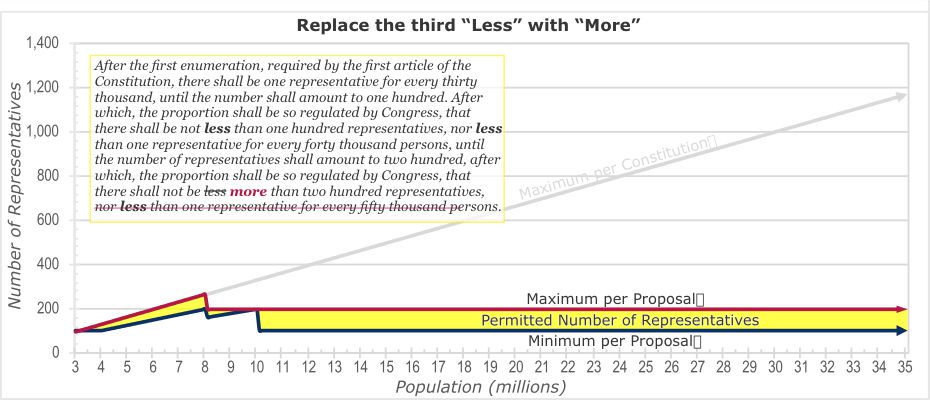
Though it provides a somewhat erratic solution, it is mathematically coherent. And there is a precedent for it, as it is very similar to the solution proposed by the Committee of Eleven back on August 14, 1789. Moreover, it could be argued that the notion of deleting the final words was assumed, without it having been explicitly stated; there is precedent for that with respect to the (rejected) motions made in the House on August 14th and in the Senate on September 2nd. However, we can safely assume that this alteration was not somehow intended based on the fact that Messrs. Madison’s and Ellsworth’s instructions both specifically referenced the replacement of the final instance of “less”.
Given the immense importance of these proposed amendments, if Congress had intended any such modification to the first Article, they would have certainly made additional deletions to, or modifications of, the text in order to produce a coherent proposal for submission to the states’ legislatures.
Conclusion
We are forced to conclude that, in September of 1789, the engrossing clerks in the House (William Lambert) and and Senate (Benjamin Bankson) did exactly what they were instructed to do. Moreover, it stands to reason they were well supervised in this task by James Madison. So if this were not a scrivener’s error, then how could such a grievous alteration have been made to the proposal which was fully coherent ten days earlier? As it turns out, what actually transpired is far more interesting.
© Thirty-Thousand.org May 1, 2025

- 1“The Treaties and Conventions Concluded Between the United States of America and Other powers since July 4, 1776” (Revised Edition). Government Printing Office. 1873. ↩︎
- 2United States Congress 1789). House, Thomas Greenleaf, James Madison Pamphlet Collection, and Printed Ephemera Collection. Congress of the United States, in the House of Representatives, Monday, 24th August: resolved, by the Senate and House of Representatives … that the following articles be proposed to the legislatures of the several states, as amendments to the Constitution. [New-York: Printed by T. Greenleaf, 1789] ↩︎